Supreme Court 'Industry' Ruling Explained: Pro-Industry Verdict Or Not?
Does the Supreme Court's new 'industry' ruling actually favour employers? A breakdown of the 9-judge bench verdict, the 1978 precedent it doesn't overrule, and what changes under the 2020 Labour Code.
 Verdicto News Desk
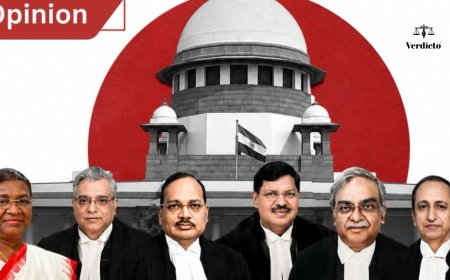
New Delhi, Aug 21: A nine-judge Constitution Bench of the Supreme Court, led by Chief Justice of India Surya Kant, ruled on August 20 that the sweeping 1978 definition of "industry" will not automatically apply to the Industrial Relations Code, 2020. The verdict has been widely read as a win for employers. Whether that framing holds up depends on which part of the judgment is being weighed.
The case traces back to Bangalore Water Supply and Sewerage Board v. R. Rajappa, a 1978 seven-judge ruling that gave "industry" an unusually broad reading under the Industrial Disputes Act, 1947. That definition extended labour protections, including collective bargaining rights and recourse against unfair practices, to hospitals, universities, clubs and government welfare departments. For nearly five decades it served as the default benchmark for deciding who qualified as an "industry" and who did not.
Defending the newer 2020 Code, the Union government argued that this old standard should not dictate how the new law is read, contending that welfare and charitable activities run by the state should not be classified as industry. Whether the 1978 precedent should govern the new Code was the question referred to the nine-judge bench.
The majority held that "industry" under the Code must be interpreted from its "own text and context," not from the 1978 judgment. Chief Justice Kant was explicit that the older verdict "would not act as the sheet anchor" for future interpretation of the term under the new law. The 1978 test itself was not discarded: the bench held that its "triple test" for identifying an industry has "stood the test of time" and remains valid for pending disputes filed under the 1947 Act. The shift applies only prospectively, to matters arising under the new Code.
The case for reading this as pro-industry rests on what the ruling makes possible going forward. Section 2(p) of the 2020 Code excludes institutions run for charitable, social or philanthropic purposes, along with certain sovereign government functions, from the definition of industry. Under the 1978 framework, those exclusions were difficult to invoke, since many welfare bodies were still captured by the older test's breadth. With that precedent no longer binding on the new Code, courts have more room to read the statutory carve-outs on their own terms, giving employers and institutions firmer ground to argue they fall outside labour code obligations. This also tracks what the Centre argued for directly, and the majority's reasoning moves in that direction.
The case against a simple pro-industry label rests on what the ruling stops short of doing. It does not disturb the 1978 test for any matter already in the system; existing and pending disputes under the 1947 Act continue to be decided under the older, more expansive standard. The bench was also not unanimous on the underlying merits. Justice Joymalya Bagchi agreed with the Chief Justice and Justice Narasimha only on the procedural question of whether the case could be reconsidered, while aligning with dissenting judges Justices Nagarathna, Datta and Bhuyan in holding that the 1978 judgment had correctly determined the scope of "industry." That split indicates real disagreement within the bench over how far worker protections should extend, rather than a clean outcome on one side.
Most significantly, the ruling does not itself declare that hospitals, universities or NGOs now fall outside "industry" status. It removes the automatic presumption that they are included, but whether they end up inside or outside the definition under the 2020 Code will depend on how tribunals and courts apply the Code's text in individual cases going forward, a process that has not yet begun.
Read together, the ruling is best described as structurally favourable to employers, in that it removes a labour-friendly precedent as the automatic reference point for disputes under the new Code. It is not a blanket pro-industry verdict. It preserves the older, expansive protections for existing and pending cases, reflects genuine disagreement among the judges, and leaves the actual boundaries of "industry" under the 2020 Code to future litigation rather than settling the question outright. The ruling shifts the starting point of the conversation in industry's favour, but the conversation itself is far from over.