Should Students Learn a Third Language in Class 9? Supreme Court Raises Questions
The Supreme Court has questioned introducing a third language from Class 9 under the CBSE framework. Here's what the judges said, how it relates to India's three-language policy, and why the debate extends beyond politics.
 Verdicto News Desk
New Delhi, July 16: The Supreme Court's recent observations on the introduction of a third language from Class 9 have reignited a long-standing debate over India's language policy. While the issue before the Court was not the constitutional validity of the Central Board of Secondary Education's (CBSE) language framework, the judges' remarks have shifted public attention to a different question: Is Class 9 the right stage for students to begin learning a new language?
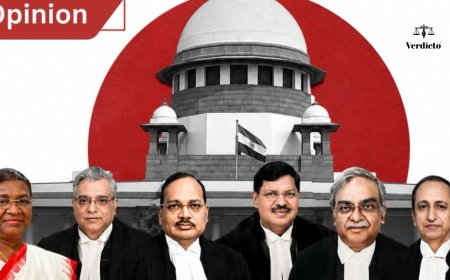
During the hearing of a case concerning the establishment of Jawahar Navodaya Vidyalayas (JNVs) in Tamil Nadu, a Bench of Justices B.V. Nagarathna and R. Mahadevan expressed concern over the timing of introducing a third language. Justice Nagarathna observed that Class 9 is already an academically demanding stage and suggested that if students are to learn an additional language, it would be more appropriate to introduce it in Classes 5 or 6.
The observations were oral and do not constitute a binding judicial direction. Nevertheless, they have added a new dimension to India's ongoing debate over multilingual education by raising questions about implementation rather than the policy itself.
What Did the Supreme Court Actually Say?
The Court was hearing Tamil Nadu's appeal against a Madras High Court order directing the state to facilitate the establishment of Jawahar Navodaya Vidyalayas in every district. Tamil Nadu has historically opposed Navodaya schools because they follow the three-language formula, which the state argues conflicts with its long-standing two-language policy.
During the proceedings, the state's counsel submitted that under the CBSE framework, a third language becomes compulsory from Class 9. Responding to this, Justice Nagarathna remarked that introducing a new language at that stage could unnecessarily increase students' stress.
She suggested that if a third language is to be taught, it should begin much earlier—during middle school—when language acquisition is generally easier and academic pressure is comparatively lower.
Importantly, the Bench also clarified another point that often dominates public discourse. Justice Nagarathna observed that the policy does not mandate Hindi as the third language.
"The State language has to be taught, English has to be taught and any third language. It doesn't say Hindi," she remarked.
These observations distinguish the Court's concern from the larger political debate surrounding language imposition.
Why the Timing Matters
The Supreme Court's remarks focus on when a third language should be introduced rather than whether multilingual education is desirable.
Educational research has long suggested that children acquire additional languages more effectively during their early and middle school years. Younger learners often develop pronunciation, vocabulary and comprehension with greater ease than adolescents, making early exposure a common feature of multilingual education systems across the world.
By Class 9, however, students begin preparing for board examinations and encounter a significantly heavier academic workload. Adding a new compulsory language at this stage, the Court suggested, could increase rather than reduce educational pressure.
Although the Court did not cite pedagogical studies, its observations align with a broader educational view that language learning is generally more effective when introduced gradually during foundational years.
The Three-Language Policy: What Does It Aim to Achieve?
India's three-language formula has existed in various forms since the recommendations of the Kothari Commission in the 1960s and was incorporated into the National Policy on Education in 1968. The objective has been to promote multilingualism while balancing regional languages, English and another Indian language.
The National Education Policy (NEP) 2020 reaffirmed multilingual education but also emphasised flexibility. It states that no language should be imposed on any state or student and encourages instruction in the mother tongue or regional language during the early years wherever possible.
In principle, the policy seeks to strengthen linguistic diversity rather than privilege a single language.
Its implementation, however, has remained politically contentious.
Why Tamil Nadu Continues to Oppose It
Tamil Nadu has consistently followed a two-language policy—Tamil and English—and has opposed the three-language formula for decades. Successive governments in the state have argued that requiring students to learn an additional language imposes an unnecessary academic burden and raises concerns about indirect promotion of Hindi.
Although the Centre maintains that students are free to choose any Indian language as the third language, political debates have frequently centred on whether the policy may eventually encourage Hindi over regional languages.
The Supreme Court's observations, however, did not endorse either side of this political disagreement. Instead, they focused on the educational implications of introducing a new language at a relatively late stage of schooling.
Oral Remarks Are Not the Law
It is important to distinguish between judicial observations and judicial orders.
The Bench's comments were made during oral arguments and do not alter the CBSE policy or create any legal obligation for the Centre. Another Bench of the Supreme Court, headed by Chief Justice Surya Kant, is already hearing challenges to aspects of the CBSE's language policy and has declined to stay its implementation.
This means the legal questions surrounding the policy remain open and will be decided separately.
Even so, oral observations from the Supreme Court often influence public debate and may shape future policy discussions, particularly when they concern issues affecting millions of students.
Beyond Politics, a Question of Educational Design
Language policy in India has traditionally been debated through the lens of identity, federalism and politics. The Supreme Court's remarks have introduced another perspective—that of educational design.
Rather than questioning multilingualism itself, the Court asked whether policymakers have chosen the right stage in a student's academic journey to introduce an additional language.
As India continues to implement the National Education Policy and states negotiate its language provisions, that question may prove just as significant as the political debates that have long surrounded the three-language formula.
For now, the Supreme Court has not questioned the objective of multilingual education. It has simply asked whether the current timing best serves the interests of students.