Can the United Nations Finally Elect Its First Woman Secretary-General? Here's How the Selection Process Really Works
As the race to replace António Guterres begins, five women are among seven candidates for UN Secretary-General. Here's how the UN selection process works, why the Security Council holds decisive power, and whether the world body is ready for its first female leader.
 Verdicto News Desk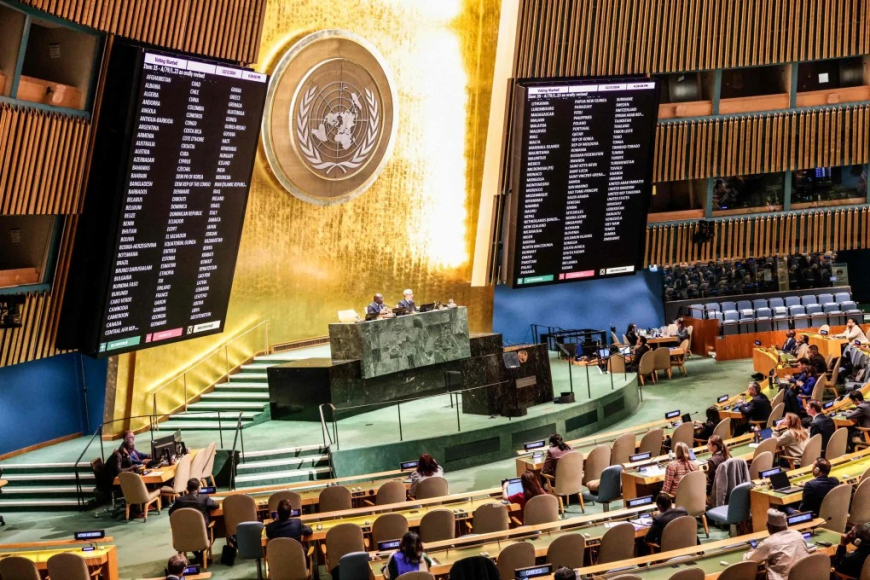
New Delhi, July 16: The United Nations has spent decades championing gender equality, urging governments to increase women's participation in politics, diplomacy and public life. Yet, in its own 80-year history, the world's largest multilateral organisation has never been led by a woman.
That paradox has resurfaced as the race to succeed Secretary-General António Guterres formally begins. Of the seven candidates currently in the fray, five are women, prompting renewed calls for the UN to finally break one of its oldest institutional barriers. The debate gained further momentum this week after the United States said there was "no reason" why the next Secretary-General could not be a woman.
But gender alone will not decide the outcome.
The appointment of the UN Secretary-General is neither a direct election nor a transparent recruitment process. Instead, it is one of the most politically negotiated appointments in global governance, shaped less by campaign promises than by closed-door diplomacy among the five permanent members of the Security Council. While every UN member state ultimately votes in the General Assembly, the decisive contest takes place long before the matter reaches the wider membership.
As the selection process unfolds, the central question is no longer whether the UN is ready for its first woman leader. It is whether the geopolitical realities of the Security Council will allow history to be made.
An Institution That Advocates Equality—but Has Never Practised It at the Top
The United Nations has consistently placed gender equality at the centre of its development agenda. Sustainable Development Goal 5 calls for equal participation of women in leadership and decision-making, while successive UN agencies have encouraged governments to dismantle barriers preventing women from occupying positions of power.
Yet the organisation itself presents a striking contradiction.
Since 1945, nine men have served as Secretary-General, from Norway's Trygve Lie to the current Secretary-General António Guterres. During the same period, women have headed governments, central banks, international courts and multilateral financial institutions. The UN, however, has never appointed a woman to its highest office.
Recognising this inconsistency, the UN General Assembly adopted a resolution in September 2025 expressing regret that no woman has ever held the office of Secretary-General and encouraging member states to nominate women. Although politically significant, the resolution does not alter the legal framework governing the appointment.
What the UN Charter Actually Says
The office of the Secretary-General is established under Article 97 of the UN Charter, which provides that:
"The Secretary-General shall be appointed by the General Assembly upon the recommendation of the Security Council."
The provision is notable for what it does not say.
The Charter imposes no requirement relating to gender, nationality, region or previous office. There is no constitutional obstacle preventing a woman from becoming Secretary-General. Nor is there any legal requirement that the office rotate among geographical regions.
This means that the absence of a female Secretary-General is not the consequence of legal exclusion but of political outcomes produced by the appointment process.
The Security Council Decides Before the General Assembly Votes
Public attention often focuses on the General Assembly because all 193 member states participate in the final appointment. In practice, however, the decisive stage occurs inside the Security Council.
The Council conducts several rounds of confidential "straw polls" to determine which candidates command sufficient support. These informal votes are designed to identify not only the strongest candidate but, more importantly, whether any of the Council's five permanent members—the United States, Russia, China, the United Kingdom or France—intend to exercise their veto.
A candidate who faces opposition from even one permanent member rarely survives the process.
Only after the Security Council agrees on a single recommendation does the matter proceed to the General Assembly for formal appointment.
Consequently, while the General Assembly provides democratic legitimacy, the Security Council effectively determines who reaches the finish line.
Why the Process Faces Persistent Criticism
For years, academics, diplomats and civil society organisations have questioned whether the current appointment process reflects contemporary principles of transparency and accountability.
Unlike elections for many other international offices, negotiations over the Secretary-General largely occur behind closed doors. Candidates rarely campaign publicly, member states disclose little about their preferences, and the decisive discussions remain confidential.
Although recent reforms introduced public dialogues with candidates and greater disclosure of their visions for the organisation, the Security Council's veto power continues to dominate the process.
Critics argue that this structure allows geopolitical interests to outweigh considerations such as administrative competence, institutional reform or representational diversity.
Supporters counter that the Secretary-General cannot effectively function without the confidence of the world's major powers and that consensus among the permanent members remains essential for the organisation's stability.
Does Regional Rotation Matter?
Alongside gender, another issue shaping the current contest is regional representation.
The UN Charter contains no rule requiring rotation among geographical regions. Nevertheless, over time, an informal convention has developed whereby different regions are expected to have an opportunity to lead the organisation.
Many diplomats argue that Latin America and the Caribbean should produce the next Secretary-General because the region has not held the office in recent decades under the prevailing understanding of regional balance.
Several leading candidates—including former Chilean President Michelle Bachelet, UNCTAD Secretary-General Rebeca Grynspan and former President of the General Assembly María Fernanda Espinosa—reflect that expectation.
However, regional rotation remains a diplomatic practice rather than a binding legal principle.
The Strongest Opportunity Yet
The current field is historically significant not merely because five women are contesting the office but because several possess extensive experience across national governments and international institutions.
The candidates include former presidents, senior UN officials, ambassadors and heads of specialised agencies, reflecting a depth of experience that strengthens the argument that gender is no longer a limiting factor in the availability of qualified leadership.
The United States' recent statement that there is "no reason" a woman cannot lead the United Nations also signals that at least one permanent member is publicly open to such an outcome. Whether similar support exists among the other veto powers remains uncertain.
History suggests that endorsements matter less than geopolitical consensus.
Beyond Symbolism
Electing the first woman Secretary-General would undoubtedly mark a historic milestone for the United Nations. Yet reducing the contest to gender alone risks overlooking the substantive challenges awaiting the next leader.
The incoming Secretary-General will inherit an organisation grappling with wars in multiple regions, climate negotiations, humanitarian crises, sustainable development financing and increasing divisions among major powers.
Under Article 99 of the UN Charter, the Secretary-General possesses the unique authority to bring matters threatening international peace and security before the Security Council. The office also serves as the UN's chief diplomat, administrator and public representative.
The demands of the position require political neutrality, diplomatic credibility and the ability to navigate an increasingly polarised international system.
The United Nations does not need to amend its Charter to elect its first woman Secretary-General. The law has never prevented it.
What has stood in the way is politics.
The coming months will therefore test not whether qualified women exist—they clearly do—but whether the Security Council's permanent members are prepared to align their geopolitical interests with the values of equality the United Nations has long promoted.
If that consensus emerges, the organisation may finally correct one of the most enduring contradictions in its own institutional history. If it does not, the world's foremost advocate of gender equality will once again confront uncomfortable questions about the gap between its principles and its practice.