EC's New Form 6 Rule: Can a Statutory Election Form Be Altered Without a Legal Amendment?
Can the Election Commission introduce new requirements in Form 6 without amending election law? Verdicto explains the legal, constitutional and administrative issues.
 Verdicto News Desk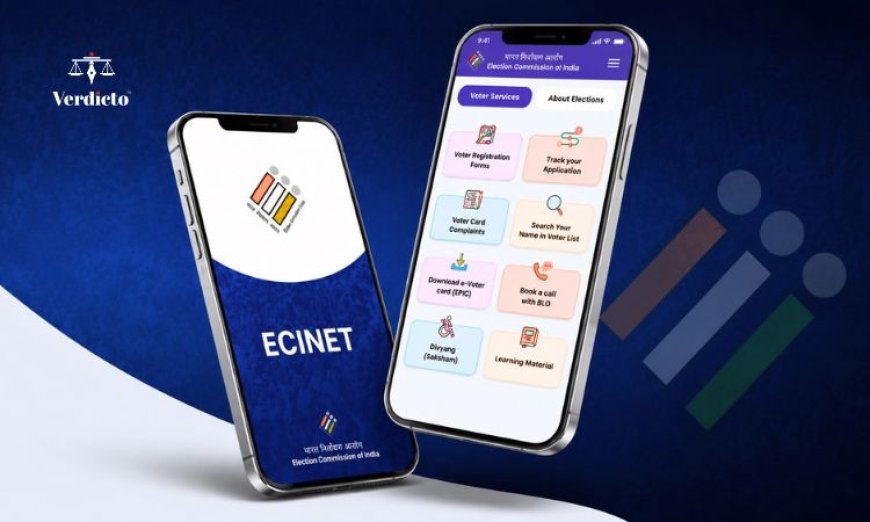
New Delhi, July 13: The Election Commission of India (ECI) has introduced a new requirement on its online voter registration portal, ECINET, requiring first-time voter applicants to disclose whether their parents were included in the last Special Intensive Revision (SIR) of electoral rolls. If the answer is yes, applicants must also furnish details such as the Assembly Constituency number, polling booth (Part Number), and the serial number of their parent's name in that revision.
However, the move has sparked a legal debate because Form 6—the statutory application form for inclusion of names in the electoral roll—has not been formally amended under the Representation of the People Act, 1950 and the Registration of Electors Rules, 1960.
The development raises an important question: Can an online administrative portal introduce additional statutory requirements without a formal amendment to the law?
What Has Changed?
Applicants using the ECINET portal for fresh voter registration are now required to complete an additional "Declaration" section asking whether either parent was included in the last SIR.
If the answer is "Yes", applicants must provide:
-
Assembly Constituency number
-
Part (Polling Booth) Number
-
Serial Number of the parent in the last SIR
If "No", applicants are required to provide their parents' names and, where available, their EPIC (Voter ID) numbers.
Interestingly, the downloadable offline version of Form 6 available on ECINET does not contain this additional declaration, indicating that the statutory form itself remains unchanged.
What Does the Law Say?
Constitutional Framework
Article 326
Article 326 of the Constitution provides for universal adult suffrage, allowing every citizen aged 18 years or above, who is ordinarily resident in a constituency and not otherwise disqualified by law, to be registered as a voter.
Importantly, eligibility to vote can only be regulated by law—not by administrative convenience.
Statutory Framework
The legal framework governing electoral registration consists primarily of:
-
Representation of the People Act, 1950
-
Registration of Electors Rules, 1960
Under Section 28 of the Representation of the People Act, 1950, the Central Government, after consulting the Election Commission, may frame or amend rules through a Gazette Notification.
Any amendment to statutory forms prescribed under these Rules ordinarily follows this procedure.
Has Form 6 Been Amended?
As of now, no Gazette Notification has been issued amending Form 6.
This creates an unusual situation:
| Offline Form 6 | Online ECINET Form |
|---|---|
| No SIR declaration | SIR declaration mandatory |
The divergence raises questions about whether an administrative portal can effectively impose requirements absent from the statutory form.
The Core Legal Question
The issue is not whether the Election Commission can verify voter identity.
Rather, the question is:
Can an executive or administrative instruction introduce a requirement into a statutory form without following the rule-making procedure prescribed under law?
This is fundamentally a question of administrative law.
Administrative Instructions vs Statutory Rules
Indian courts have consistently distinguished between:
Statutory Rules
-
Have force of law
-
Made under powers delegated by Parliament
-
Require prescribed amendment procedures
Administrative Instructions
-
Guide implementation
-
Cannot override or modify statutory provisions
-
Cannot create new legal obligations inconsistent with existing law
If Form 6 is prescribed under statutory rules, adding mandatory disclosures through an online portal may invite judicial scrutiny regarding whether the change amounts to a de facto amendment without following due process.
Does Article 324 Give the EC Such Power?
The Election Commission derives its constitutional authority from Article 324, which vests it with the superintendence, direction and control of elections.
The Supreme Court has recognised that Article 324 grants broad powers where legislation is silent.
However, the Court has also consistently held that Article 324 cannot be exercised contrary to an existing statute or statutory rules. Where Parliament has enacted a law, the Commission is generally expected to function within that legislative framework.
The legal debate, therefore, is whether the additional declaration is merely an administrative aid or whether it effectively alters the statutory enrolment process.
Could This Affect New Voters?
The Election Commission has not clarified whether applications lacking parental SIR details will be rejected or subjected to enhanced scrutiny.
For first-time voters—particularly those whose parents:
-
have shifted residence,
-
are deceased,
-
never possessed EPIC cards,
-
or cannot easily trace electoral records,
the additional declaration may become an administrative hurdle.
Whether this ultimately affects enrolment remains unclear.
Why the SIR Context Matters
The issue assumes significance because the Commission is simultaneously conducting a nationwide Special Intensive Revision of electoral rolls.
Unlike routine annual revisions, the SIR requires large-scale verification of electors and has resulted in the deletion of millions of names across several states on grounds including death, migration, duplicate registration and non-verification.
The introduction of parental SIR linkage into new voter registration appears to extend the significance of the SIR beyond the revision exercise itself, although the Commission has not officially explained its legal basis.
Questions That Remain Unanswered
Several legal and procedural questions remain open:
-
Under which statutory provision was the new declaration introduced?
-
If Form 6 remains unchanged, how can additional mandatory fields be required online?
-
Is the declaration optional or mandatory?
-
Will failure to furnish parental SIR details affect registration?
-
Has the Union Government approved any amendment?
-
Why does the online form differ from the statutory offline form?
The Bigger Constitutional Debate
This issue extends beyond electoral registration.
It touches upon a broader constitutional concern:
Can government digital platforms effectively modify legal procedures without corresponding amendments to the governing law?
As governance increasingly shifts to digital portals, courts may eventually have to determine whether administrative software can lawfully impose obligations that the statute itself does not expressly require.
Verdicto Analysis
At first glance, the controversy appears procedural. In reality, it raises foundational questions about delegated legislation, administrative discretion, statutory interpretation, and the rule of law.
The Election Commission undoubtedly possesses wide constitutional authority to ensure free and fair elections. Yet, where Parliament has prescribed a statutory form through subordinate legislation, any substantive alteration ordinarily follows the legislative process laid down under the Representation of the People Act and the Registration of Electors Rules.
Whether the new ECINET declaration is merely an administrative facilitation measure or amounts to an unauthorized modification of a statutory form is ultimately a question that may require judicial interpretation.
The controversy serves as a contemporary case study on the interaction between Article 324, delegated legislation, administrative law, and universal adult suffrage under Article 326.