When the Court Blinked: The Supreme Court's Retreat on Governors' Powers
How Governors’ delays in assenting to state Bills have reshaped Indian federalism, and why the Supreme Court’s 2025 reversal weakened constitutional remedies against procedural vetoes.
 Verdicto News Desk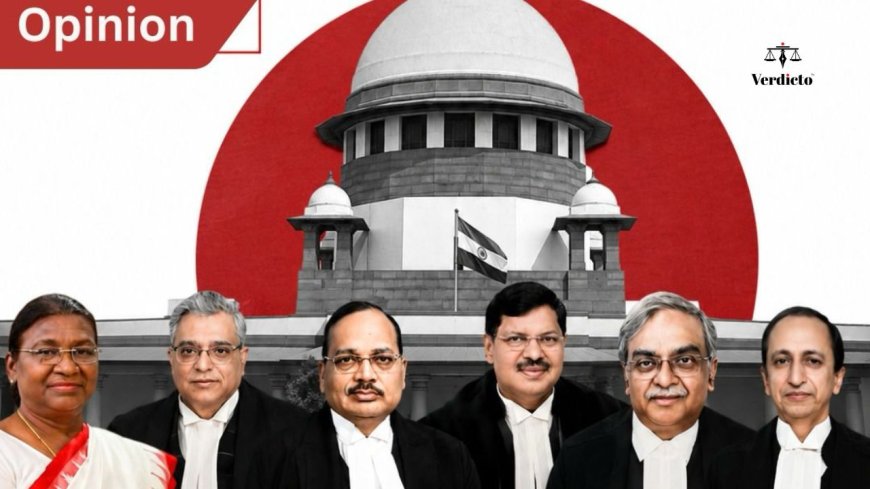
The Indian Constitution gives a Governor three options when a Bill passed by a state legislature is placed before him. He may assent to it, in which case it becomes law. He may withhold assent and return it to the legislature for reconsideration. Or he may reserve it for the President's consideration. What the Constitution does not say is how long any of this may take, or what happens if the Governor simply does nothing.
That silence has been exploited with increasing frequency. In Tamil Nadu, Governor R.N. Ravi kept ten Bills pending for years, eventually reserving them for the President after the legislature re-passed them, a manoeuvre the Tamil Nadu government described, not inaccurately, as a constitutional runaround. In Kerala, Punjab, Telangana, and West Bengal, Governors appointed by the central government sat on Bills passed by elected legislatures without explanation, without a timeline, without consequence. The pattern was clear enough: delay itself had become a veto. Not a formal veto, the Constitution doesn't allow that, but a functional one, achieved through inaction and constitutional silence.
For a while, the Supreme Court appeared ready to say that this was not acceptable.
When the Court Appeared Ready to Intervene
The first serious judicial intervention came in November 2023, when a two-judge bench in State of Punjab v. Principal Secretary to the Governor held that the words ‘as soon as possible’ in Article 200's proviso conveyed ‘utmost urgency.’ The Court disapproved of governors’ inaction, stating that Governors were ‘thwarting the normal course of lawmaking.’ Pocket veto, indefinitely withholding assent without formally returning the Bill, was held unconstitutional. The Governor had to act, and act urgently.
Then came April 8, 2025. A two-judge bench of Justices J.B. Pardiwala and R. Mahadevan delivered what looked like a landmark. In State of Tamil Nadu v. Governor of Tamil Nadu, the Court declared Governor Ravi's conduct ‘illegal and erroneous in law.’ It ruled there was no such thing as an absolute veto or a pocket veto under Article 200. Once a legislature re-passes a Bill after the Governor's return, the Governor must assent; no further discretion remains. The Court laid down specific timelines for both the Governor and the President to act on Bills. It expanded judicial review, giving state governments the right to approach courts for a writ of mandamus if those timelines were breached. And, invoking its extraordinary powers under Article 142, the bench held the ten Tamil Nadu Bills as ‘deemed to have received assent.’
That last move — deemed assent — was the most consequential. It meant that a court could, in effect, substitute the Governor's constitutionally assigned action with its own order.
It was a strong position. It did not last.
Judicial Retreat and the Limits of Constitutional Enforcement
On May 13, 2025, the President of India invoked Article 143 — the rarely used advisory jurisdiction — to refer fourteen questions to the Supreme Court, asking for a reconsideration of the principles laid down in the April judgment.
On November 20, 2025, a five-judge Constitution Bench headed by Chief Justice B.R. Gavai delivered its advisory opinion. Which stated that courts cannot prescribe judicially mandated timelines for Governors to act on Bills; the concept of ‘deemed assent’ does not exist under the Constitution, since one constitutional authority cannot substitute for another; and decisions by the Governor and the President under Articles 200 and 201 are, in principle, not justiciable.
The two-judge bench's April judgment was explicitly overruled.
What remains is a narrower principle: prolonged and deliberate inaction can still be reviewed by courts on the grounds of mala fides or manifest arbitrariness. In extreme cases, a court may ask a Governor to act — but cannot tell him which of the three constitutional options to choose. The Court acknowledged that ‘indefinite stalling cannot be allowed to defeat democratic governance’ while simultaneously removing the tools that would have made that statement enforceable.
This is the tension at the centre of the November ruling. It did acknowledge the issue but did not provide a remedy for it.
Federalism, Delay, and Democratic Accountability
The practical stakes are not abstract. India's federal structure distributes legislative power between the Union and the states, with elected state legislatures making laws on matters within their domain. Governors are not elected. They are appointed by the President, which in practice means by the Union cabinet. When an opposition-ruled state passes legislation that the central government dislikes, and the centrally appointed Governor delays that legislation indefinitely without legal consequence, the constitutional design of federal autonomy is being circumvented through a procedural channel.
The Sarkaria Commission in 1988 and the Punchhi Commission in 2010 both recommended that Governors should act on Bills within a reasonable time and that their discretionary powers be narrowly construed. Those recommendations sat unimplemented for decades. The courts, for most of that period, declined to intervene meaningfully. What changed from 2023 to April 2025 was a brief period of judicial willingness to say that constitutional offices had enforceable obligations, not merely moral ones.
The November 2025 ruling retreated from that position. By striking down deemed assent and rejecting judicially prescribed timelines, the Constitution Bench returned the situation to something close to where it began: a Governor who wishes to delay can delay, and the constitutional remedy for that delay is limited to extreme cases of demonstrable bad faith — a standard that is difficult to establish and slow to adjudicate.
The argument that ‘indefinite delay is reviewable’ sounds forceful. But judicial review that cannot produce a remedy within a relevant timeframe is, in practice, no review at all. A Bill that is delayed for two years while a legal challenge works its way through courts is, functionally, a Bill that has been vetoed — even if no one ever formally said so.
Procedure has become power.
The Danger of Procedural Power
What the courts have declined to do and what the November ruling makes clear they will not do is treat constitutional silence as a constitutional command. The drafters of the Constitution did not use the word ‘deemed assent’, but they did not use the words ‘in his discretion’ from the draft of Article 200 precisely because they did not intend Governors to exercise personal political judgment over state legislation.
There is a broader institutional pattern here that goes beyond any single judgment. Courts in India have periodically asserted themselves against constitutional overreach in the basic structure doctrine, in the right to privacy, in earlier rulings on Governor’s conduct and have then, under various forms of pressure, retreated to narrower ground. The April-to-November arc on Governor powers is a compressed version of that pattern. Between those two judgments’ readings, the practical situation for opposition-ruled states changed very little.
The Constitution did not design Governors as political executives parallel to elected governments. It designed them as constitutional functionaries operating within a framework of responsible governance. When they act as agents of central political will, delaying legislation that the party in power at the Centre dislikes, they are doing something the Constitution did not intend. When courts acknowledge this and then decline to remedy it, the Constitution's intent is defeated not through formal violation but through procedural attrition.
The danger, as always, is not the moment of obvious breakdown. It is the slow normalisation of arrangements that accumulate into a different constitutional reality over time. A Governor who delays for two years. A court that reviews but cannot compel. A federal structure in which the elected state legislature discovers, in practice, that its legislative mandate is conditional on the approval of someone it did not elect and cannot remove.
And this drift, if not failure in terms of constitutional spirit, would be considerably harder to correct.