Can a Chief Minister refuse to resign after losing an election? The short answer is simple: not for long. India’s constitutional framework leaves little room for such a situation to persist, even if a leader initially resists resignation.
The question came into sharp focus on Tuesday after Mamata Banerjee, leader of the Trinamool Congress, stated that she would not resign as Chief Minister after the electoral defeat in West Bengal. She argued that her party had not genuinely lost the mandate and alleged that the verdict had been manipulated in favour of the BJP. Banerjee claimed that several seats were “stolen” and accused the Election Commission of bias, suggesting that democratic processes had been undermined.
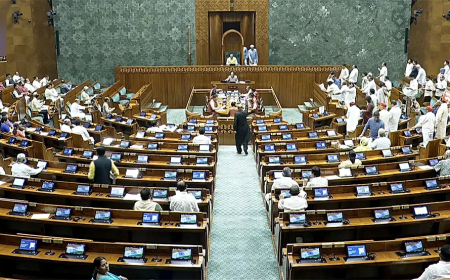
However, India’s constitutional framework is clear in principle, even if it does not spell out every procedural detail. A Chief Minister must command the confidence of the State Legislative Assembly. In this scenario, the Trinamool Congress was reduced to 80 seats in the 294-member West Bengal Legislative Assembly, while the BJP secured 207 seats — comfortably crossing the majority mark of 147.
Once election results establish that the incumbent government no longer enjoys majority support, constitutional convention requires the Chief Minister to resign.
This principle is not merely ceremonial. It flows directly from the foundation of parliamentary democracy, where executive authority is derived from the elected legislature. A government that lacks the confidence of the Assembly cannot continue indefinitely in office.
If a Chief Minister refuses to step down voluntarily, the Governor possesses constitutional authority to intervene. Under Article 164 of the Constitution of India, ministers hold office “during the pleasure of the Governor.” In constitutional practice, this means that when a Chief Minister clearly loses majority support, the Governor may step in to ensure that governance continues according to constitutional norms.
Article 164 states:
“The Chief Minister shall be appointed by the Governor and the other Ministers shall be appointed by the Governor on the advice of the Chief Minister, and the Ministers shall hold office during the pleasure of the Governor.”
In practical terms, the Governor has several constitutional options. The first and most accepted course is to ask the outgoing Chief Minister to prove majority on the floor of the House through a floor test. If the loss of majority is already beyond dispute, the Governor may invite the leader of the majority party or coalition to form the new government.
The Governor’s role in such circumstances is not political, but constitutional. The office exists to ensure continuity of governance and adherence to democratic legitimacy.
Another relevant constitutional provision is Article 172, which prescribes a five-year term for a State Legislative Assembly unless dissolved earlier. However, Article 172 protects the tenure of the Assembly — not the tenure of a Chief Minister who has lost majority support within that Assembly.
Therefore, even though the Assembly itself continues, the executive leadership must reflect the numerical reality inside the House.
In the present West Bengal scenario, the constitutional position appears straightforward. Once it becomes evident that the ruling party no longer commands majority support, the constitutional process shifts to the Governor to facilitate the transition of power.
India’s constitutional democracy ultimately rests on one central principle: governments survive not by assertion, but by numbers on the floor of the House.
Follow Verdicto on WhatsApp for legal news and constitutional explainers.

 Verdicto News Desk