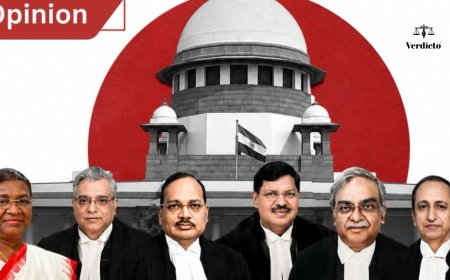
Time to End Public Interest Litigation?
Centre questions the relevance of Public Interest Litigation before the Supreme Court, sparking a constitutional debate on access to justice and misuse of PILs.
 Verdicto News Desk
A significant constitutional question has emerged before the Supreme Court of India: has Public Interest Litigation (PIL) outlived its purpose?
The issue arose during hearings in the Sabarimala review case, where the Central Government questioned the continued relevance of PILs. The debate was triggered when Justice B. V. Nagarathna raised concerns over petitions filed by individuals who were not devotees, asking whether such cases should have been entertained at all.
Representing the Centre, Solicitor General Tushar Mehta urged the Constitution Bench to reconsider the very foundation of PILs. In written submissions, the government argued that the mechanism—once a powerful tool to ensure access to justice for marginalized communities—has now lost its original relevance.
According to the Centre, PILs were conceived in an era when large sections of the population were unable to approach courts due to structural barriers such as poverty, illiteracy, and lack of legal support. However, with the expansion of legal aid institutions and technological advancements like e-filing, access to justice has improved significantly. In this context, the government contended that PIL jurisdiction has expanded excessively and is often misused for “agenda-driven” litigation.
The Centre went a step further, suggesting that PIL as a concept should be done away with, and that courts should revert to traditional principles of locus standi—allowing only those directly affected to seek judicial remedies. It argued that the growing number of PIL filings has burdened the judiciary, with only a small fraction of cases being genuinely in public interest.
However, the Supreme Court did not appear convinced that such a drastic step is necessary. Chief Justice Surya Kant observed that courts have, over time, evolved safeguards to deal with frivolous petitions. He noted that the judiciary is now far more cautious in entertaining PILs, issuing notices only in cases where substantial merit is found.
The discussion unfolded in the backdrop of the Sabarimala case, which itself raises complex constitutional questions involving the balance between women’s rights and religious freedom. The Court also indicated that broader issues, beyond the specific dispute, are under consideration, including the scope of judicial intervention in matters of faith and tradition.
The Centre’s stance has reignited a long-standing debate within the legal community. While PILs have played a transformative role in Indian constitutional jurisprudence, addressing issues ranging from environmental protection to human rights violations, they have also been criticized for enabling judicial overreach and misuse by vested interests.
At its core, the controversy raises a fundamental question about the nature of access to justice: should courts remain open to public-spirited individuals raising collective concerns, or should they limit intervention strictly to those directly affected?
As the Constitution Bench continues to hear the matter, its eventual observations could have far-reaching implications, not just for PILs, but for the broader framework of constitutional litigation in India.
📌 Follow us on YouTube, Instagram, and Twitter for more updates.