Can Raghav Chadha Legally Merge AAP with BJP?
Defection or constitutional merger? Here’s the legal breakdown of whether Raghav Chadha and 6 other AAP Rajya Sabha MPs can join BJP without disqualification under the Tenth Schedule.
 Verdicto News Desk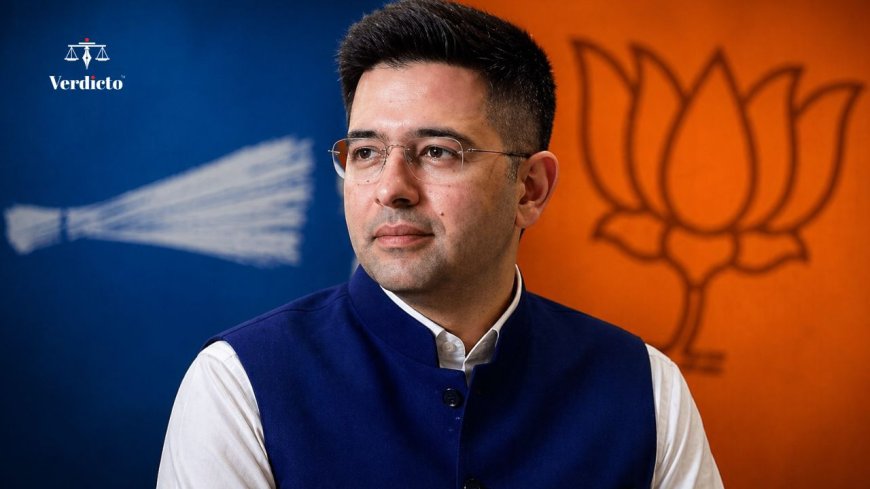
Raghav Chadha’s announcement that he and six other Aam Aadmi Party (AAP) Rajya Sabha members have merged with the Bharatiya Janata Party (BJP) is not merely a political development; it is a constitutional stress test for India’s anti-defection framework. The claim that this move is protected under the Tenth Schedule because two-thirds of AAP’s Rajya Sabha MPs have agreed to the merger raises one of the most significant legal questions in contemporary parliamentary democracy: can a legislature party independently merge itself into another political party without the original political party itself deciding to merge?
The answer to that question goes far beyond AAP, BJP, or the immediate political implications for Punjab ahead of the Assembly elections. It touches the very purpose of the anti-defection law and the constitutional relationship between elected representatives and the political parties on whose mandate they enter Parliament.
The Constitutional Framework of the Anti-Defection Law
The anti-defection law, introduced through the Fifty-Second Constitutional Amendment in 1985, was enacted to curb the rampant culture of political defections that had destabilized governments across the country. Paragraph 2 of the Tenth Schedule provides that a legislator is liable for disqualification if they voluntarily give up membership of the political party on whose ticket they were elected.
The Supreme Court has repeatedly treated this principle as central to parliamentary stability and constitutional morality, even describing defection as a “constitutional sin” in the Harish Chandra Rawat matter.
Ordinarily, therefore, a Member of Parliament elected on an AAP ticket cannot simply join the BJP without attracting disqualification. The only constitutional shield available is found in Paragraph 4 of the Tenth Schedule, which creates an exception in cases of merger. It provides that a member shall not be disqualified if their original political party merges with another political party and if not less than two-thirds of the members of the legislature party have agreed to such merger.
At first glance, Chadha’s argument appears to rely squarely on this provision. If seven out of ten AAP Rajya Sabha MPs have agreed to move to the BJP, they may claim that the two-thirds threshold has been satisfied and that disqualification does not follow.
However, such a reading ignores the most important constitutional distinction embedded within Paragraph 4.
Political Party vs Legislature Party: The Core Legal Distinction
The distinction between a “political party” and a “legislature party” is the heart of this controversy.
A political party refers to the original party organization—the national structure, leadership, and institutional identity of the Aam Aadmi Party. A legislature party, on the other hand, refers only to the elected members of that party within a legislative House.
Paragraph 4 does not say that legislators may merge if the legislature party decides to do so. It specifically states that protection from disqualification arises only when the “original political party” merges with another political party. The agreement of two-thirds of the legislature party is not the source of the merger; it is only the condition that gives effect to a merger that must first originate in the original political party.
This distinction is not merely textual but foundational to the purpose of the anti-defection law. If a handful of MPs could declare that the entire political party has merged into another formation, legislators would effectively gain the power to hijack party identity and electoral mandate.
Constitutional lawyers often describe this as the “tail wagging the dog.” The legislature party is a product of the political party, not its master.
What the Supreme Court Said in the Subhash Desai Case
This position finds strong support in the Supreme Court’s Constitution Bench judgment in Subhash Desai v. Principal Secretary, Governor of Maharashtra (2023), which arose from the Shiv Sena split involving the Eknath Shinde and Uddhav Thackeray factions.
Although the case did not directly concern Paragraph 4 mergers, the Court made a crucial observation that legislative majority cannot determine the identity of the political party. It held that a legislature party cannot function independently of the political party and warned that the Tenth Schedule would become unworkable if “political party” were read as “legislature party.”
The Court explicitly stated that there is a clear demarcation between political party and legislature party for the purpose of merger under Paragraph 4. It noted that reading the two terms interchangeably would defeat the purpose of the anti-defection law by allowing legislators to disconnect themselves from the very political organization on whose platform they sought votes and entered office.
That observation directly weakens the legal foundation of the present AAP-BJP merger claim.
The Goa Exception: A Conflicting High Court View
The issue, however, is not entirely settled because of a conflicting interpretation from the Bombay High Court’s Goa Bench.
In 2019, ten out of fifteen Congress MLAs in the Goa Legislative Assembly joined the BJP and claimed protection under Paragraph 4. The Speaker accepted the merger, and in 2022, the High Court upheld that decision.
The Court held that the support of two-thirds of the legislature party was sufficient to constitute a valid merger, even in the absence of a formal merger by the original political party itself.
This interpretation has been widely criticized for isolating Paragraph 4(2) from Paragraph 4(1) and allowing legislators to trigger merger protection without organizational approval from the parent party. Such a reading effectively converts the anti-defection law into a mechanism for legitimizing mass defections rather than preventing them.
The matter is now pending before the Supreme Court, and its eventual ruling will likely have a direct bearing on the present controversy involving AAP MPs.
Sanjay Singh’s Disqualification Petition
AAP leader and Rajya Sabha MP Sanjay Singh has already approached the Rajya Sabha Chairman, seeking disqualification of the seven MPs on the ground that they have voluntarily given up membership of the party and joined the BJP.
His argument is legally straightforward: these members were elected to the Upper House on AAP’s mandate, and unless the original political party itself has formally merged with the BJP, their act amounts to defection under Paragraph 2, not protected merger under Paragraph 4.
Politically, AAP has described this as another instance of “Operation Lotus,” accusing the BJP of engineering defections to weaken opposition governments and destabilize Punjab ahead of crucial elections.
Legally, however, the issue is not about political narrative but constitutional procedure. Was there a genuine merger of political parties, or was there only a coordinated exit by legislators seeking shelter under a constitutional loophole?
Why This Case Matters Beyond AAP and BJP
This is not merely a dispute about seven MPs crossing over from AAP to BJP. It is about whether India still believes that voters elect parties and principles, or merely individuals who can change allegiance once the election is over.
If the Court allows legislature parties to independently engineer mergers, it would create a dangerous precedent where electoral mandates become negotiable commodities and parliamentary loyalty becomes a matter of arithmetic rather than principle.
If it reaffirms that only the original political party can initiate a merger, it may restore some meaning to a law that many believe has already failed in practice.
Few laws in India have disappointed as thoroughly as the anti-defection law. A statute intended to prevent political betrayal has often rewarded it. Individual defections are punished, but collective defections are protected. Speakers and Chairpersons delay disqualification proceedings for months or years, allowing defectors to complete entire terms without consequence.
Constitutional morality is frequently sacrificed at the altar of political convenience.
The Final Constitutional Question
The Supreme Court must now decide whether Paragraph 4 is a constitutional safeguard for genuine mergers or a legal shortcut for engineered defections.
Can legislators merge themselves, or can they only follow a merger initiated by the political party itself?
The answer will determine whether the anti-defection law remains a shield for democracy or becomes its most sophisticated loophole.
Democracy is not protected only at the ballot box; it is protected in what happens after the votes are counted. If elected representatives can rewrite the mandate overnight through technical interpretations of constitutional provisions, then the law is no longer defending democracy—it is legitimizing its erosion.
That is why this case matters.
And that is why the battle over seven Rajya Sabha MPs may ultimately become one of the most important constitutional tests of this decade.
📌 Follow us on YouTube, Instagram, and Twitter for more updates.