Can Animal Sacrifice Be Banned? Supreme Court Issues Notice to Centre on PIL
The Supreme Court has issued notice to the Centre on a PIL seeking a ban on animal sacrifice in the name of religion and challenging Section 28 of the PCA Act.
 Verdicto News Desk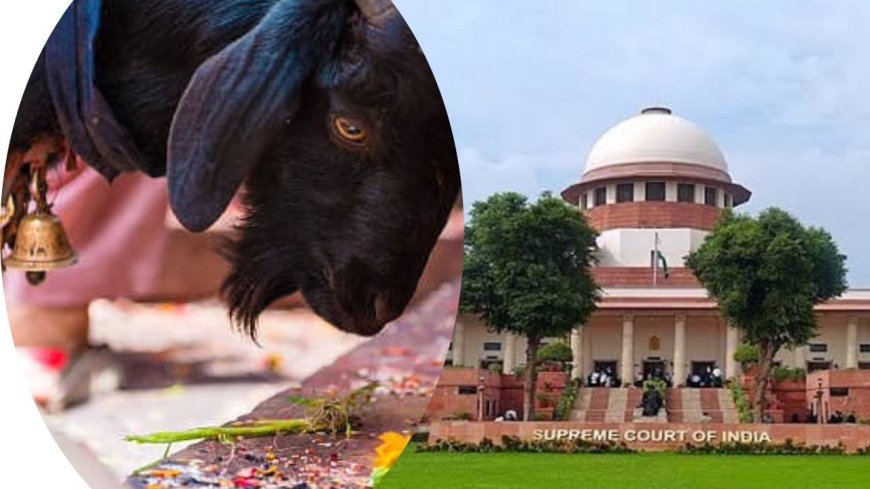
The Supreme Court on Thursday issued notice on a Public Interest Litigation (PIL) seeking a ban on the killing of animals in the name of religion.
A Bench of Justice Vikram Nath and Justice Sandeep Mehta passed the order while hearing a petition filed by Advocate Shruti Bist. The Court sought a response from the Union government and listed the matter for further hearing after four weeks.
The petition has urged the Court to direct the Ministry of Animal Husbandry to amend Section 28 of the Prevention of Cruelty to Animals Act, 1960, which currently provides an exemption allowing animals to be killed if the act is required by the religion of any community.
Challenge to Section 28 of the PCA Act
Section 28 of the Prevention of Cruelty to Animals Act states:
The petitioner has challenged this provision, arguing that it effectively legalises animal sacrifice performed as part of religious practices and allows acts of cruelty to continue under statutory protection.
According to the plea, the exemption undermines the broader purpose of animal welfare legislation and fails to adequately safeguard animals from harm.
Allegations of Widespread Animal Cruelty
The PIL highlights multiple forms of cruelty faced by animals in India, including neglect and abandonment, physical and emotional abuse, ritualistic animal abuse, animal hoarding, the use of animals in entertainment, laboratory testing, and farm animal exploitation.
The petition states that animals such as dogs, cats, horses, and livestock frequently suffer abuse in various settings.
“Some people in India abuse animals for selfish gain, while others do it to demonstrate dominance or express disdain for innocent creatures,” the petitioner states.
Historical Context of Animal Sacrifice
The petition also refers to the historical roots of animal sacrifice in certain religious traditions. According to the plea, the practice has existed in some Hindu rituals, particularly in the worship of Goddess Durga and Goddess Kali.
The petitioner notes that the practice declined during periods when the principles of non-violence associated with Jainism and Buddhism gained prominence but later resurfaced in certain communities.
At present, animal sacrifice is reportedly practiced in parts of India’s Himalayan belt, northeastern states, Odisha, West Bengal, Maharashtra, and southern India. Similar practices also exist in countries such as Nepal and Indonesia.
The petition further claims that young male animals are often selected for ritual sacrifice, though historical accounts also mention rare instances where humans themselves were offered as sacrifices in ancient traditions.
Legal Angle: Religious Freedom vs Animal Welfare
The case raises significant constitutional questions about the balance between religious freedom and animal protection laws in India.
Under Constitution of India Article 25, every citizen has the fundamental right to freely profess, practice, and propagate religion. However, this right is not absolute and is subject to public order, morality, health, and other constitutional considerations.
At the same time, the Prevention of Cruelty to Animals Act, 1960 serves as India’s primary legislation aimed at preventing cruelty to animals. Section 28 of the Act creates an exception by allowing animal killing when it is required by the religion of a community.
The PIL essentially asks the Supreme Court to examine whether this statutory exemption undermines the objective of animal protection laws.
Another constitutional dimension arises from Constitution of India Article 51A(g), which places a fundamental duty on citizens to show compassion towards living creatures.
The Supreme Court has previously emphasised animal welfare in the landmark judgment of Animal Welfare Board of India v. A. Nagaraja, where it held that animals have a right to live with intrinsic dignity and protection from unnecessary suffering.
Key Legal Questions Before the Court
The petition raises several important legal questions that the Court may eventually have to consider:
- Scope of Religious Freedom:
Whether animal sacrifice qualifies as an essential religious practice protected under Article 25 of the Constitution.
- Validity of Section 28:
Whether the exemption under Section 28 of the Prevention of Cruelty to Animals Act is consistent with the broader objective of preventing cruelty to animals.
- Recognition of Animal Rights:
Whether existing constitutional principles and judicial precedents require stronger legal protection for animals.
Possible Implications of the Case
If the Court proceeds to examine the issue in detail, the case could have far-reaching implications for both religious practices and animal welfare laws in India.
- Review of Religious Exemptions:
A ruling in favour of the petition could trigger reconsideration of statutory provisions that permit animal sacrifice in religious contexts.
- Expansion of Animal Rights Jurisprudence:
The case could further strengthen judicial recognition of animal welfare as a constitutional value linked to compassion for living beings.
Any restrictions imposed by the Court could affect traditional practices followed by certain communities and regions, potentially sparking broader debates on the limits of religious freedom.
The matter is expected to return before the Supreme Court after the Union government files its response.
📌 Follow us on YouTube, Instagram, and Twitter for more updates.