ED vs West Bengal in Supreme Court: Can a central agency invoke Article 32?
Clash of power in the Supreme Court: ED alleges obstruction, West Bengal cries “weaponisation.” The case could redefine Article 32 and the limits of federal investigative authority — explained by Verdicto.
 Verdicto News Desk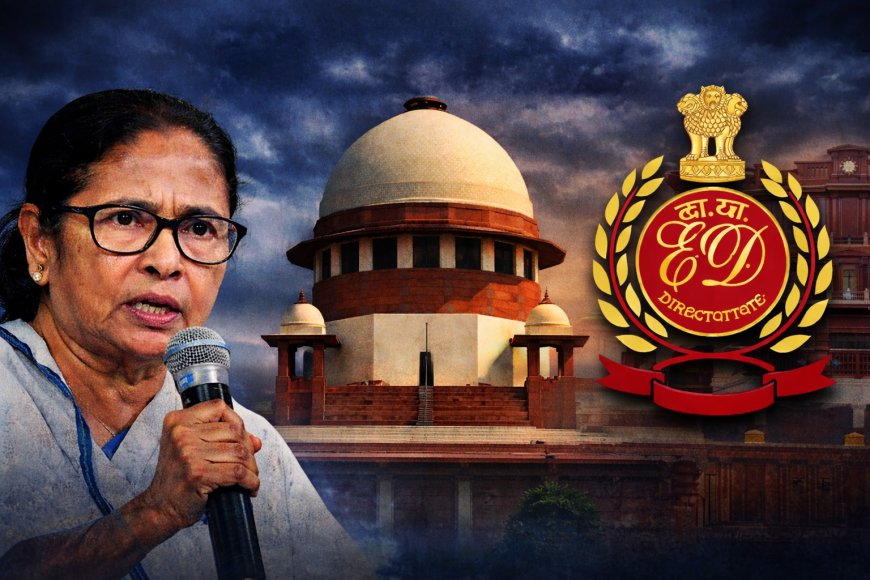
The Supreme Court of India witnessed a sharp exchange between counsel representing the State of West Bengal and the Enforcement Directorate (ED) in a petition alleging obstruction to the agency’s searches at the premises of political consultancy firm I-PAC.
A Bench of Justices Prashant Kumar Mishra and K.V. Viswanathan adjourned the matter to March 18 after hearing preliminary submissions on the maintainability of the ED’s plea filed under Article 32 of the Constitution.
“Weaponised” vs “Terrorised”
Senior Advocate Sidharth Luthra, appearing for the State of West Bengal, argued that the ED was being “weaponised” against the State. Additional Solicitor General S.V. Raju, representing the ED, countered that the agency itself had been “terrorised” and prevented from performing its statutory duties.
Solicitor General Tushar Mehta submitted that the case raises a significant constitutional question concerning the scope of Article 32. The State has challenged the maintainability of the ED’s petition, contending that Article 32 is a remedy available to citizens for enforcement of fundamental rights and cannot be invoked by a government agency.
Senior Advocate Abhishek Manu Singhvi objected to the Centre’s submissions on maintainability, stating that the Court had earlier kept the issue open for adjudication. Senior Advocate Menaka Guruswamy also opposed the issuance of notice on a related writ petition filed by a private individual, questioning its credibility.
Background to the dispute
The controversy stems from events on January 8, when West Bengal Chief Minister Mamata Banerjee entered the I-PAC office and the residence of its co-founder while ED officials were conducting searches linked to a money laundering probe arising from an alleged coal smuggling operation.
According to the ED, the intervention led to the removal of physical and electronic material relevant to its investigation and obstructed officers from carrying out search proceedings. The agency has sought directions for a probe by the Central Bureau of Investigation (CBI) into the incident.
The State, in its affidavit, has denied any obstruction and relied on the search panchnama to assert that the proceedings were conducted without interference. It has further argued that an instrumentality of the State such as the ED cannot claim violation of fundamental rights to maintain a petition under Article 32.
Earlier proceedings
The ED had initially approached the Calcutta High Court; however, the matter could not be taken up due to disruptions in the courtroom. The agency subsequently moved the Supreme Court, which on January 15 observed that the issues raised required judicial examination to prevent “lawlessness” and issued notice to the respondents.
With pleadings now exchanged, the Court will next examine the constitutional question of whether a central investigative agency can invoke Article 32 against a State government in the context of alleged obstruction to investigative proceedings.
📌 Follow us on YouTube, Instagram, and Twitter for more updates.