
Fiscal Federalism on Trial: Does the Union Budget Undermine States’ Constitutional Rights?
Is fiscal federalism slowly dying? A legal breakdown of how the Union Budget impacts states’ financial autonomy. Read more on Verdicto.
 Verdicto News Desk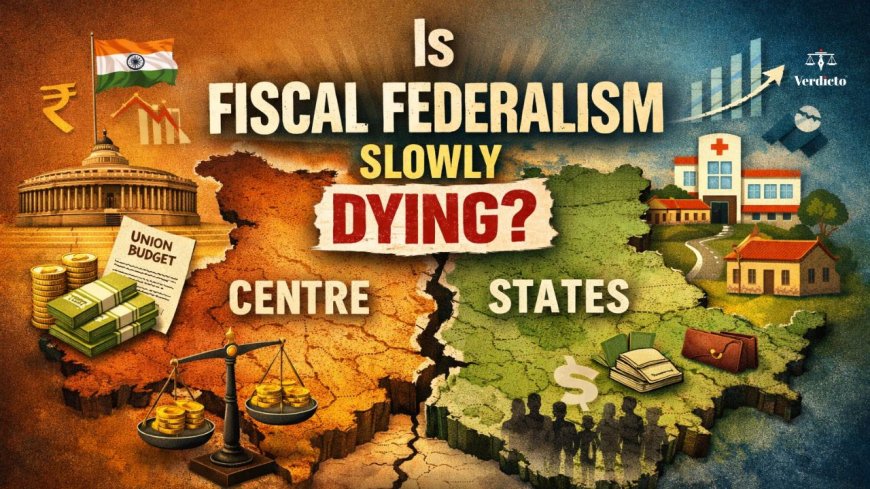
Every Union Budget promises to strengthen cooperative federalism. Yet, year after year, states across political lines report shrinking financial autonomy. Behind the numbers lies a deeper constitutional question: is India’s fiscal architecture drifting away from the federal balance promised by the Constitution?
This Budget, like those before it, brings fiscal federalism into sharp focus, not as a political debate, but as a constitutional concern.
Fiscal federalism refers to the distribution of financial powers and responsibilities between the Union and the States.
While states are responsible for delivering essential public services—healthcare, education, policing, transport, welfare schemes—the Centre controls the most lucrative sources of revenue, including income tax, corporate tax, and customs duties.
The Constitution sought to bridge this imbalance through:
- Article 246 – Divides taxing powers between the Centre and States
- Article 270 – Mandates the sharing of central taxes with states
- Article 280 – Establishes the Finance Commission to ensure equitable distribution
The Supreme Court has recognised fiscal federalism as part of India’s federal structure, which forms part of the Basic Structure of the Constitution (State of West Bengal v. Union of India, 1963; S.R. Bommai v. Union of India, 1994).
Despite the constitutional framework, India has witnessed a steady centralisation of fiscal power, particularly after the introduction of GST.
1. GST and the Loss of State Tax Autonomy
GST subsumed several state taxes, making states heavily dependent on the Centre for compensation. Delays and disputes over GST compensation have exposed the vulnerability of states in the new fiscal regime.
While GST was sold as “one nation, one tax,” it also meant one major tax collector—the Union.
Legal perspective:
The Supreme Court, in Mohinder Singh Gill v. Chief Election Commissioner (1978), noted that fiscal arrangements should not dilute the federal character of governance. Though GST was introduced via a constitutional amendment, the reliance on central compensation underscores the potential for financial dependence to limit state autonomy.
Instead of giving states untied grants, recent Budgets have relied heavily on:
- Centrally Sponsored Schemes
- Performance-linked incentives
- Target-based funding models
These funds come with strict conditions, leaving states with little flexibility to address local priorities. States increasingly function as implementing agencies of centrally designed schemes, rather than autonomous units of governance.
Legal lens:
The Supreme Court in State of Rajasthan v. Union of India (1977) emphasised that financial dependence should not compromise state discretion in implementing schemes or laws. Excessive conditionality risks reducing states to “mere agents” of the Centre—a challenge to the spirit of Articles 245–255.
The Finance Commission is constitutionally envisaged as a neutral arbiter. However:
- Its recommendations are not binding
- Budgets often bypass them through discretionary allocations
SC Observation:
In T.N. Seshan v. Union of India (1995), the Court stressed that deviation from the Finance Commission’s recommendations should not undermine the principles of federalism. Ignoring these guidelines can erode the balance intended under Article 280.
The evolving fiscal structure raises serious legal issues:
- Does excessive central control over finances violate federalism as a basic feature (Kesavananda Bharati v. State of Kerala, 1973)?
- Can the Union indirectly curtail state powers through financial dependence?
- Does ignoring the spirit of the Finance Commission undermine Article 280 and cooperative federalism?
Courts traditionally avoid intervening in day-to-day budget matters. But systematic erosion of state autonomy may invite judicial scrutiny, especially if it threatens the federal character of the Constitution.
Fiscal federalism is not an abstract legal concept. Its impact is visible in:
- Underfunded state healthcare systems
- Stalled welfare schemes
- Weak environmental enforcement
- Delayed infrastructure at the local level
When states lack fiscal autonomy, citizens pay the price.
India’s Constitution does not envision a unitary state operating through financial dominance. It envisages a Union of States, bound by cooperation, trust, and constitutional balance.
Budgets may be economic documents, but their design has profound constitutional implications. Strengthening fiscal federalism is not about Centre versus States, it is about preserving the constitutional architecture of Indian democracy.
As Parliament debates allocations and opposition raises concerns, the real question remains unanswered:
Can India sustain its federal character if states are fiscally dependent on the Centre?
📌 Follow us on YouTube, Instagram, and Twitter for more updates.