Labour Codes Under Fire: Nationwide Strike Challenges ‘Pro-Corporate’ Policies
A legal analysis of the nationwide strike against Labour Codes and pro-corporate policies. What laws are trade unions challenging?
 Verdicto News Desk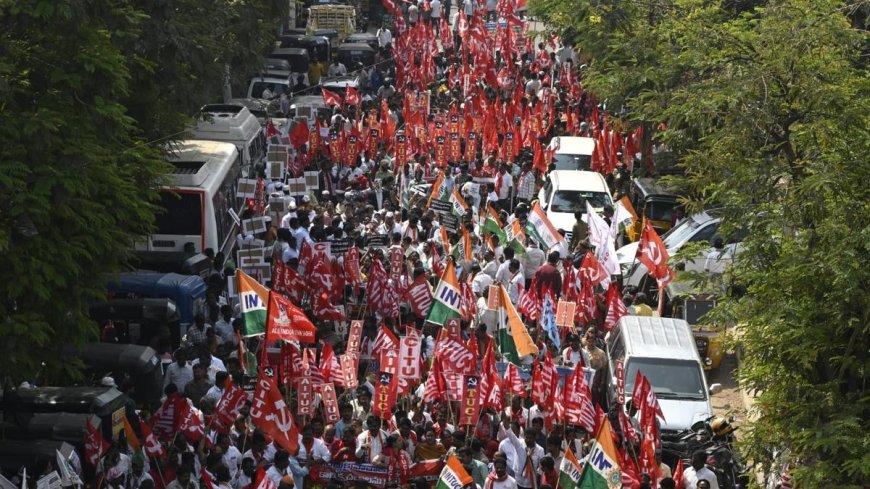
Employees and workers associated with a joint forum of central trade unions observed a day-long nationwide strike on Thursday, describing it as a protest against what they termed “anti-worker, anti-farmer and pro-corporate policies” of the central government.
The forum claimed that nearly 30 crore workers were mobilised for the general strike. The protest was directed primarily against the four Labour Codes and certain proposed legislations, including the Draft Seed Bill, the Electricity Amendment Bill and the proposed SHANTI Act.
Here is a legal explainer on the key laws being opposed.
1. The Four Labour Codes
Between 2019 and 2020, Parliament consolidated 29 central labour laws into four codes:
- Code on Wages, 2019
- Industrial Relations Code, 2020
- Code on Social Security, 2020
- Occupational Safety, Health and Working Conditions Code, 2020
Although enacted, the codes are yet to be fully implemented pending notification of rules.
Why Are They Being Opposed?
Trade unions have demanded that the four codes be scrapped. Their concerns include:
(a) Industrial Relations Code, 2020
- Requires a 14-day prior notice before strikes in all industrial establishments.
- Raises the threshold for prior government approval for layoffs and retrenchment from 100 to 300 workers.
Unions state that these provisions weaken collective bargaining and job security.
(b) Code on Social Security, 2020
- Introduces provisions for gig and platform workers.
- Allows framing of welfare schemes for unorganised workers.
Unions argue that the benefits are scheme-based and not guaranteed entitlements, and that funding mechanisms lack clarity.
(c) Code on Wages, 2019
- Introduces a national floor wage.
- Extends minimum wage provisions to all sectors.
Trade unions have demanded higher minimum wages and clearer wage protection mechanisms.
(d) Occupational Safety Code, 2020
- Replaces multiple workplace safety laws.
- Introduces an “Inspector-cum-Facilitator” model.
Unions have raised concerns regarding inspection and enforcement mechanisms.
2. Electricity (Amendment) Bill
The Electricity (Amendment) Bill proposes reforms in the power distribution sector, including:
- Introduction of multiple distribution licensees in the same area.
- De-licensing of distribution in certain contexts.
- Changes in tariff determination and subsidy framework.
Trade unions argue that the proposed changes may lead to privatisation of power distribution and affect public sector electricity employees.
The Bill has faced opposition from several states and power sector unions in the past.
3. Draft Seed Bill
The Draft Seed Bill seeks to regulate seed production, certification and sale.
Key features include:
- Mandatory registration of seed varieties.
- Regulation of quality standards.
- Penalties for non-compliance.
Farmer groups and unions have expressed concerns regarding regulatory control over seed systems and possible implications for farmers’ traditional practices.
4. SHANTI Act
The proposed Sustainable Harnessing and Advancement of Nuclear Energy for Transforming India (SHANTI) Act aims to reform India’s nuclear energy framework.
While details of the final framework are awaited, the legislation is expected to:
- Encourage private sector participation in nuclear energy.
- Streamline regulatory and operational structures in the atomic energy sector.
Trade unions have raised concerns regarding privatisation, public accountability and employment implications in strategic sectors.
The government has maintained that the labour codes and related reforms are aimed at simplifying laws, improving ease of doing business and encouraging investment.
Trade unions state that these reforms reduce worker protections and expand private sector control in key areas.
The nationwide strike reflects continuing resistance from organised labour to these structural policy changes.