Menstrual Health Is a Fundamental Right: Supreme Court Brings Menstrual Dignity Under Article 21
Explained: Why the Supreme Court has held that menstrual health and access to menstrual hygiene in schools are part of the right to life and dignity under Article 21.
 Verdicto News Desk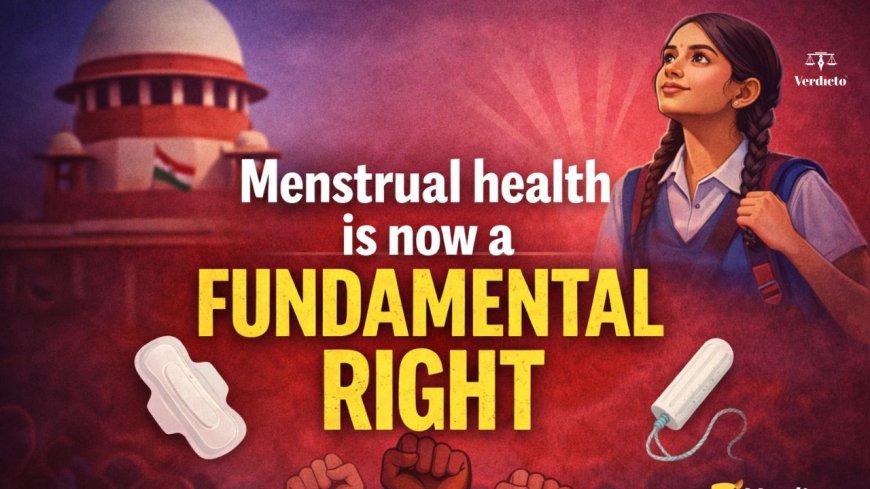
In a landmark judgment strengthening gender justice and the right to education, the Supreme Court declared that the right to menstrual health and access to menstrual hygiene management (MHM) measures in educational institutions is an integral part of the fundamental right to life and dignity under Article 21 of the Constitution.
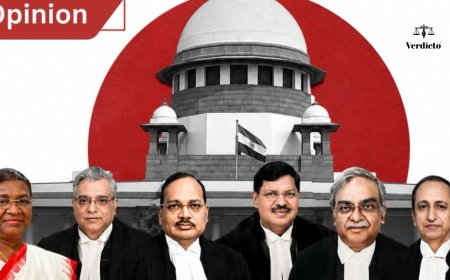
A Bench comprising Justice JB Pardiwala and Justice R. Mahadevan held that dignity cannot remain a theoretical concept and must translate into lived realities—especially for menstruating girl children who continue to face stigma, exclusion, and humiliation due to lack of basic menstrual facilities in schools.
“Dignity cannot be reduced to an abstract ideal; it must find expression in conditions that enable individuals to live without humiliation, exclusion, or avoidable suffering,” the Court observed.
Menstrual Poverty as a Constitutional Issue
The Court took serious note of menstrual poverty, stating that the absence of safe and hygienic menstrual management measures forces adolescent students to either remain absent from school or adopt unsafe practices.
According to the Bench, both outcomes violate:
- Bodily autonomy
- Right to privacy
- Right to education with dignity
The judgment underlined that menstruating girls are denied equal access to education when compared to male students or those who can afford sanitary products, leading to long-term consequences on their social and economic participation.
“There is no gainsaying that impairment of primary or secondary education has grave and lasting consequences,” the Court noted.
Violation of Privacy and Bodily Autonomy
Importantly, the Supreme Court explicitly recognised that the lack of MHM facilities in schools amounts to a violation of the right to privacy and bodily autonomy of students, rights already protected under Article 21.
The Court acknowledged that menstrual disorders are common during reproductive years and can cause significant physical and psychological distress, making institutional support not a matter of charity, but of constitutional obligation.
The Case Before the Court
The judgment arose from a writ petition filed by Dr. Jaya Thakur, who highlighted the nationwide lack of menstrual hygiene facilities in schools. The petition flagged alarming outcomes such as:
- Regular absenteeism
- Increased dropout rates
- Health risks due to unsafe menstrual practices
Accepting these concerns, the Court firmly located menstrual health within the framework of human dignity, equality, and substantive access to education.
Why This Judgment Matters
This ruling marks a crucial shift:
- Menstrual health is no longer seen as a welfare issue
- It is now recognised as a constitutional right
- The State’s obligation extends beyond policy promises to actual implementation
By constitutionalising menstrual dignity, the Supreme Court has taken a decisive step towards ensuring that biology does not become a barrier to education, equality, or self-respect.
📌 Follow us on YouTube, Instagram, and Twitter for more updates.