West Bengal Polls: Supreme Court to Seek Report on Voter Roll Tribunals
Ahead of West Bengal polls 2026, the Supreme Court said it will seek a report from the Calcutta High Court Chief Justice on the functioning of Appellate Tribunals handling voter roll exclusion appeals during the Special Intensive Revision (SIR).
 Verdicto News Desk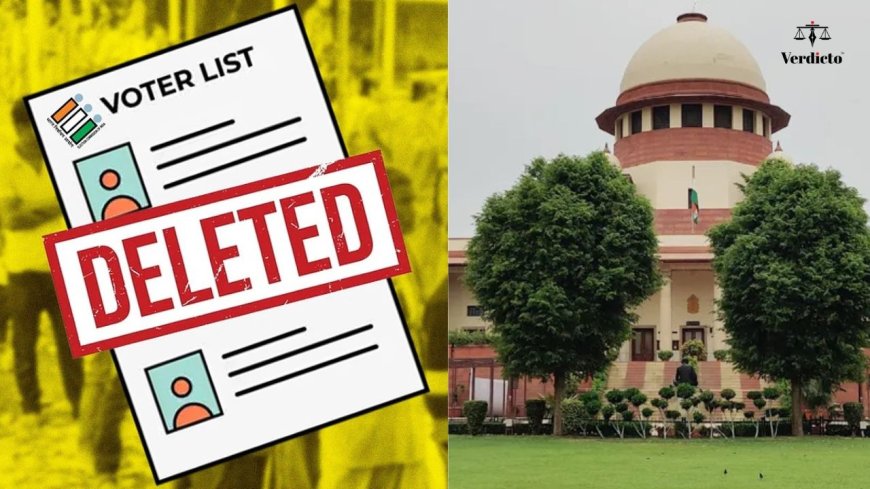
With the first phase of West Bengal elections scheduled for April 23, the Supreme Court on Monday (April 20, 2026) sought a report from the Chief Justice of the Calcutta High Court regarding the functioning of Appellate Tribunals constituted to hear appeals of voters excluded from the electoral rolls during the Special Intensive Revision (SIR).
A Bench comprising Chief Justice of India Surya Kant and Justice Joymalya Bagchi passed the direction after Senior Advocate Devdutta Kamat informed the Court that the Tribunals were allegedly “not functioning” and were creating significant procedural hurdles for citizens whose names had been deleted from the voter rolls.
Kamat, appearing for a group of petitioners whose names were excluded during the SIR process, submitted that despite the Supreme Court’s earlier directions, the Tribunals were only accepting internet and computer-based applications and were not allowing legal representation during hearings.
“There is a practical difficulty. The matter is now listed on April 24. Appellate Tribunals are not functioning. Citizens from thousands of kilometres are not allowed representation. This Court’s order is not being followed,” Kamat argued.
Responding to the concerns, CJI Surya Kant said the Court would seek an immediate report from the Calcutta High Court Chief Justice.
“We will get a report from the Chief Justice today itself,” the CJI stated.
Court Expresses Displeasure Over Repeated Mentions
At the outset, the Bench expressed visible displeasure over the repeated mentioning of the West Bengal SIR matter before the Court, with the CJI questioning whether it formed part of a “professional strategy.”
“Unfortunately, it’s a professional strategy from this side. Every day, you people, one after the other, file…” the CJI remarked, indicating frustration over multiple urgent mentions related to the electoral roll revision.
Despite this, the Bench acknowledged that it was aware of the ground realities and assured that the issue would be examined.
Kamat also informed the Court that an application had been filed seeking expedited hearings so that eligible voters could have their names included in the supplementary electoral roll before polling.
“We will see,” the CJI responded.
Supreme Court Declines Oral Plea on Bulk Form 6 Additions
Later in the day, Senior Advocate Menaka Guruswamy made an oral mention alleging that nearly seven lakh new voters were being added to the West Bengal electoral roll through Form 6—the application form used for fresh voter registration—even after the rolls had effectively been frozen.
Guruswamy argued that the Election Commission was relying on the Supreme Court’s earlier order to permit these large-scale additions, which could significantly impact the outcome of the elections.
“Your Lordships did not allow the addition of new voters in this way, using Form 6. And this is being done,” she submitted.
However, the Bench declined to entertain the submission without a formal petition.
“File a petition. We will not see like this,” the CJI said.
When Guruswamy pointed out that media reports were highlighting these developments and that complete information was still unavailable, the Court refused to proceed on the basis of newspaper reports alone.
“We can’t make a fishing inquiry like this,” the CJI observed.
The Bench clarified that any specific challenge must come through a properly filed petition and could not be entertained through oral submissions alone.
“You challenge something before us… We will examine. We can’t entertain like this,” the Court said.
Background: April 13 Supreme Court Order
The developments stem from the Supreme Court’s April 13 order, where it invoked its powers under Article 142 of the Constitution to protect the voting rights of persons whose names had been excluded from the electoral rolls during the SIR exercise.
The Court had allowed voters who succeed before the Appellate Tribunals to cast their votes in the two-phase West Bengal elections, provided their appeals are decided before April 21 and April 27 for the first and second phases respectively.
It had directed that such names be added through a “supplementary revised electoral roll” for polling scheduled on April 23 and April 29.
However, the Court had also made it clear that the mere pendency of an appeal would not automatically entitle an excluded voter to vote.
“Mere pendency of appeals preferred by excluded persons before the Appellate Tribunals shall not entitle them to exercise their right to vote,” the Bench had clarified.
The Court had also noted that more than 34 lakh appeals had already been filed before the Tribunals, not only by those alleging wrongful exclusion, but also by objectors challenging the inclusion of several persons in the revised electoral rolls.
As the election process advances, the Court’s scrutiny of the functioning of these Tribunals and the controversy over Form 6 additions is likely to remain central to the legal battle surrounding West Bengal’s voter roll revision exercise.
📌 Follow us on YouTube, Instagram, and Twitter for more updates.