Supreme Court Constitutes Expert Panel to Review Aravalli Definition and Delineation
The Supreme Court has constituted a high-powered expert committee to independently review the Centre's report on the definition and delineation of the Aravalli hill range, raising concerns over environmental protection and mining activities.
 Verdicto News Desk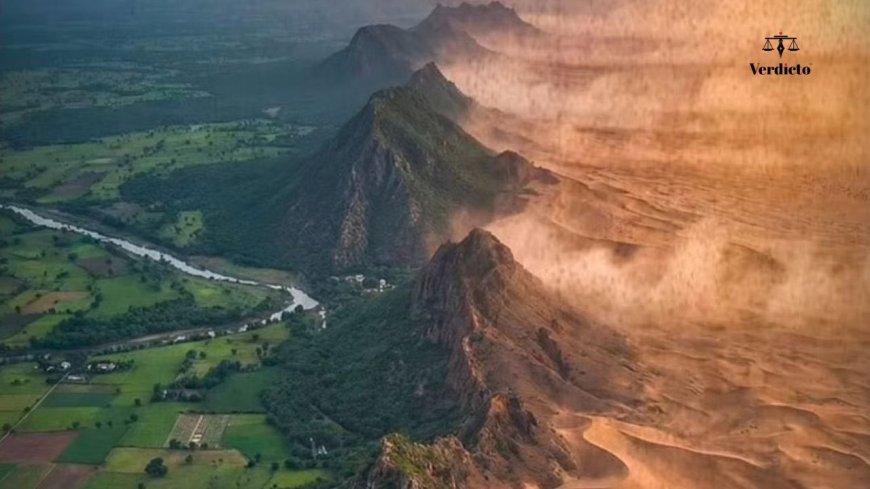
New Delhi, June 3: In a significant move aimed at strengthening the protection of the ecologically sensitive Aravalli range, the Supreme Court has constituted a High-Powered Committee (HPC) to independently review the Centre's report on the definition and delineation of the Aravalli hills.
The committee, headed by Kanchan Devi, Director General of the Indian Council of Forestry Research and Education (ICFRE), has been directed to submit a comprehensive report by August 31, 2026.
The development follows the Supreme Court's December 29, 2025 order staying the implementation of a report prepared by a Ministry of Environment, Forest and Climate Change (MoEFCC) committee chaired by the Environment Secretary. The Court had expressed concerns over the report's findings and stressed the need for an independent scientific assessment conducted by domain experts.
Why the Supreme Court Intervened
The Court observed that a "fair, impartial and independent expert opinion" was necessary to address unresolved questions surrounding the ecological boundaries of the Aravalli range and the adequacy of existing protections against mining and other environmentally damaging activities.
At the heart of the dispute is the Centre's proposed methodology for identifying the Aravalli range. The October 2025 report suggested that only hill formations located within 500 metres of two or more hills should be considered part of the Aravalli system.
The Supreme Court has questioned whether such a definition could substantially shrink the protected area and potentially allow mining operations and other developmental activities in ecologically sensitive zones.
Composition of the High-Powered Committee
The newly constituted committee will be chaired ex-officio by Kanchan Devi and includes:
-
Dr. Subhash Ashutosh, former Director General, Forest Survey of India;
-
Dr. Rajendra Kumar Sharma, former Director, Geological Survey of India;
-
Brij Mohan Singh Rathore, former Joint Secretary, MoEFCC; and
-
Prof. Ashok K. Bhatnagar, former Head, Department of Botany, University of Delhi.
The Court has also named Professor Jagdish Krishnaswamy of the Indian Institute for Human Settlements, Bengaluru, and Professor Laxmikant Sharma of the Central University of Haryana as special invitees who may be consulted by the committee whenever required.
Additionally, the Ministry of Environment has been directed to nominate an officer of Director rank to serve as Member Secretary.
Key Questions Before the Panel
The committee has been tasked with examining several critical scientific and legal issues arising from the Centre's report, including:
-
Whether the proposed 500-metre criterion artificially narrows the extent of the Aravalli ecosystem;
-
Whether hills exceeding 100 metres in elevation should be treated as part of a continuous ecological formation even when separated by larger distances;
-
Whether mining should be permitted in gaps between such hill formations; and
-
Whether existing environmental regulations adequately protect the Aravalli landscape.
The Court has also raised concerns over the report's finding that only 1,048 of Rajasthan's 12,081 hills meet the 100-metre elevation benchmark. The HPC will assess whether this conclusion is scientifically accurate and whether it risks excluding thousands of smaller hill formations from environmental safeguards.
Environmental Significance
Stretching across Rajasthan, Haryana, Delhi and Gujarat, the Aravalli range serves as a critical ecological barrier against desertification, supports groundwater recharge, and sustains biodiversity in north-western India. Environmentalists have repeatedly warned that unchecked mining and fragmentation of the hills could have severe ecological consequences for the region.
The Supreme Court's decision to seek an independent review signals continued judicial scrutiny over the protection of one of India's oldest mountain systems and could shape future environmental governance in the Aravalli region.
The case highlights the growing role of scientific evidence in environmental adjudication and underscores the judiciary's willingness to revisit administrative findings when ecological protection and public interest are at stake.