When the State Is Asked to Force-Feed a Protestor: Inside the Delhi HC's Wangchuk PIL
Does the right to life include a right to compel treatment? Verdicto unpacks the Delhi HC PIL seeking to force-feed hunger striker Sonam Wangchuk.
 Verdicto News Desk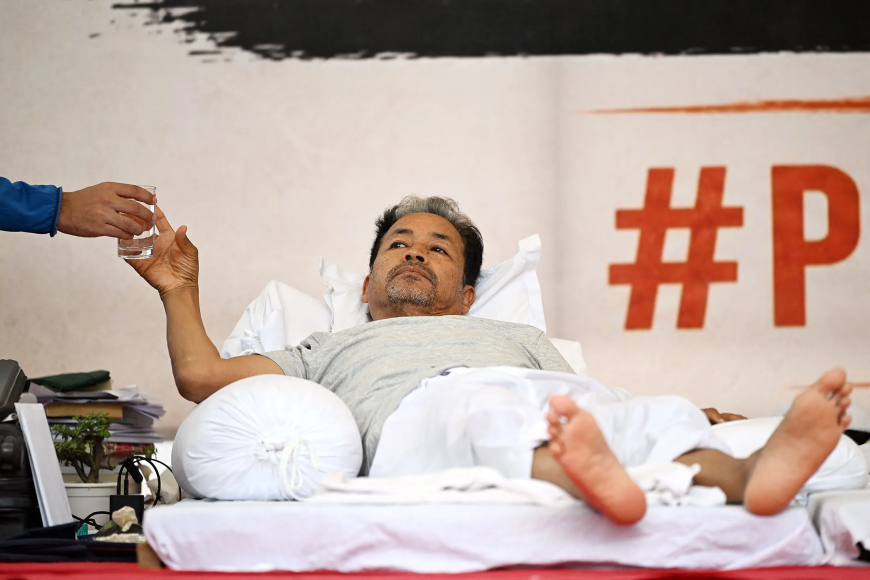
New Delhi, July 15: A court can move fast when it wants to. On Wednesday, the Delhi High Court took less than a day to treat a PIL over Sonam Wangchuk's health as urgent enough to demand government instructions overnight. What it did not do — and this is the more instructive fact — is grant any of the relief actually asked for. That gap, between urgency and restraint, is where this case actually lives.
What was asked, and what was given
Advocate Rakesh Kumar Saini's petition does not merely ask the Court to ensure Wangchuk gets medical attention. It asks the Court to direct the Union and Delhi governments to physically remove him to a hospital and administer nutrition — by force, if he does not consent — treating his eighteenth day without food as a slow-motion emergency the State is constitutionally bound to interrupt.
A Bench of Chief Justice Devendra Kumar Upadhyaya and Justice Tejas Karia gave Saini exactly one thing: a hearing date. No counsel appeared for the Union, so the matter was adjourned to Thursday, with notice ordered served on the Additional Solicitor General and GNCTD's standing counsel "having regard to the urgency." That is the entirety of Wednesday's order. Everything else — whether courts can compel treatment on an unwilling, competent adult; whether that would even be lawful; whether the executive's silence so far amounts to something closer to indifference or to appropriate caution — remains open for Thursday.
Two rights the Constitution never quite reconciled
Saini's argument rests on an appealing premise: Article 21 makes the State the guarantor of every citizen's life, and a citizen visibly dying in a public square triggers that guarantee regardless of how he got there. There is real doctrine behind this. Courts have long read Article 21 to include a right to emergency medical care, and have not hesitated to direct hospitals to act when life is at stake.
But Wangchuk's decline isn't an accident the State failed to prevent — it's the deliberate, foreseeable consequence of a choice he has made and restated daily. That distinction is exactly what the Supreme Court wrestled with in Gian Kaur v. State of Punjab (1996), when a five-judge Bench held that Article 21's right to life does not carry within it a right to die, reviving Section 309 IPC in the process. The judgment's logic wasn't indifference to autonomy — it was that a right built out of positive entitlements (to live, to health, to dignity) cannot be read backwards into a right to end the life those entitlements attach to.
Flip that reasoning around, and the PIL's real question comes into view: if there is no right to die, does the State acquire a right — or a duty — to keep someone alive against his stated wishes? Gian Kaur doesn't answer that. It was never asked to. Wangchuk isn't seeking judicial permission to die; he's exercising a form of political speech that happens to place his body at risk, which is a materially different claim.
Why "force-feed" is doing more work in this petition than it should
Aruna Shanbaug (2011) is the case most likely to get cited on Thursday, and for good reason — it's the Supreme Court's clearest word on when courts may decide what's "best" for someone's body against their own stated preference. But Shanbaug was in a persistent vegetative state; the Court invoked parens patriae precisely because she couldn't decide for herself. Wangchuk can. He is doing so publicly, repeatedly, and by all accounts with full mental clarity. Importing a doctrine built for incapacity into a case about a fully competent protestor isn't a small analogical leap — it inverts the doctrine's entire premise.
This is also why force-feeding isn't simply a medical logistics question the Court can wave through as an act of mercy. The World Medical Association's Malta Declaration — the standard ethical reference for treating physicians confronted with hunger strikers — treats forcible feeding of a competent, informed individual as inhuman and degrading treatment, not humane intervention. A court order compelling it would be authorising non-consensual medical procedure against someone who has broken no law and been found incompetent by no one. That is a categorically graver step than ordering the State to make medical care available.
The protest itself isn't incidental to the analysis
Wangchuk is not merely a private individual in medical distress; he is exercising Article 19(1)(a) and 19(1)(b) rights at Jantar Mantar, a site the Supreme Court's Ramlila Maidan judgment (arising from the 2011 crackdown on Baba Ramdev's supporters) treated as constitutionally weighted space for dissent. Hunger strikes sit awkwardly inside that protection — a legitimate, Gandhian mode of protest that nonetheless stakes the protestor's own health as its currency. A court asked to rule here isn't just balancing life against death. It's balancing the State's Article 21 obligations against the very right to protest that made the situation fraught in the first place.
The line Thursday's Bench will have to draw
Strip the petition to its most defensible core, and it survives contact with all of the above: a hunger-striking citizen's health should not go unmonitored because the government finds his underlying demand inconvenient. There's a real difference between —
- directing continuous, consent-based medical monitoring, with emergency intervention available the moment Wangchuk consents or the moment there's a genuine question about his mental competence, and
- directing that treatment be physically imposed on a competent adult who has said no.
The first sits comfortably within both the executive's Article 21 duties and the Court's supervisory jurisdiction. The second asks the judiciary to substitute its own risk tolerance for the protestor's, in a manner that — if generalised — would hand the State a template for ending any hunger strike it finds politically inconvenient, simply by having a sympathetic petitioner ask a court to intervene "for his own good."
What Thursday will actually reveal
Watch for whether the Bench's order distinguishes between facilitation and compulsion — between making a medical team and hospital bed available versus authorising force. A ruling that does the former protects Wangchuk without gutting the autonomy the Constitution otherwise extends to protestors. A ruling that grants the latter, however well-intentioned, sets a precedent that will outlive this particular protest and this particular petitioner.
The choice to adjourn rather than pass an interim order overnight already tells its own story: even treating this as urgent, the Court preferred to hear the executive before deciding how far judicial power should reach into a citizen's decision about his own body. That instinct — hear first, compel later, if at all — is likely to shape Thursday's outcome more than anything argued in Saini's petition.