US Supreme Court Strikes Down Trump’s Global Tariffs
US Supreme Court rules Donald Trump’s sweeping global tariffs unlawful, holding the president exceeded statutory authority without clear congressional approval. Key ruling on executive power and trade law.
 Verdicto News Desk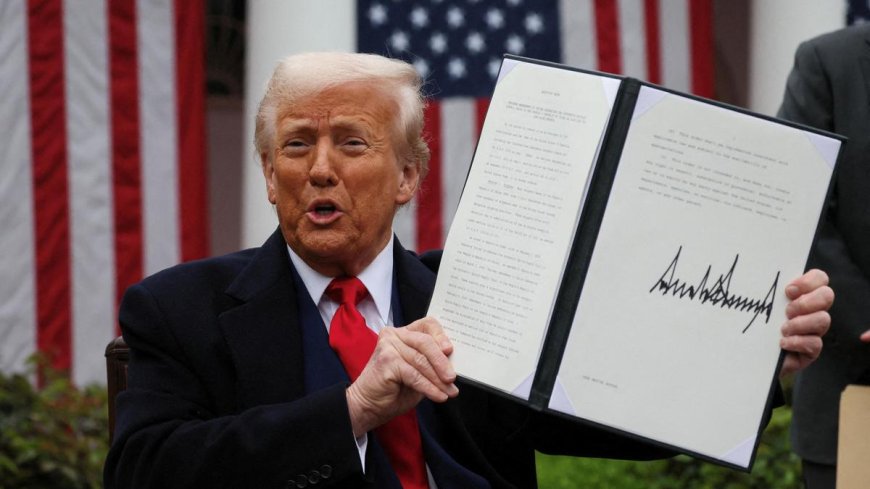
In a significant ruling on executive power and trade authority, the US Supreme Court held that Donald Trump violated federal law by unilaterally imposing sweeping tariffs across the globe. The 6–3 decision marks a major legal setback for the White House on a policy central to the administration’s economic and foreign policy agenda.
Writing for the majority, Chief Justice John Roberts held that the president cannot exercise expansive tariff powers without clear authorization from Congress. The court rejected the administration’s reliance on emergency authority, concluding that the statute cited did not support tariffs of such scale and scope.
“The president asserts the extraordinary power to unilaterally impose tariffs of unlimited amount, duration, and scope,” Roberts wrote. “In light of the breadth, history, and constitutional context of that asserted authority, he must identify clear congressional authorization to exercise it.”
The court found that the emergency powers invoked by the administration “fall short” of permitting a global tariff regime, underscoring the constitutional balance between the executive’s role in foreign affairs and Congress’s authority over taxation and commerce.
Constitutional and Statutory Limits on Executive Power
At the heart of the dispute was whether the president could rely on emergency economic authority to impose wide-ranging tariffs without legislative approval. The majority emphasized that while Congress may delegate limited discretion to the executive in matters of trade, such delegation must be explicit, particularly where measures carry significant economic consequences.
The ruling reaffirms that tariff policy, as a form of taxation affecting domestic and international commerce, remains primarily within Congress’s constitutional domain. The judgment signals judicial reluctance to interpret broadly worded statutes as conferring open-ended economic powers on the executive.
A Major Institutional Check
The decision is widely seen as the most consequential legal loss for the second Trump administration before the Court. In recent terms, the conservative bench had sided with the administration in several emergency matters involving immigration policy, restructuring of independent agencies, and spending controls. This ruling, however, underscores that judicial deference has limits where statutory authorization is unclear.
Legal and Policy Implications
The judgment may have far-reaching consequences for future administrations seeking to use emergency economic powers to reshape trade policy. It also strengthens congressional oversight over tariff measures, potentially requiring legislative engagement for major trade interventions.
For markets and global partners, the ruling introduces legal clarity but may also trigger policy recalibration in Washington. Any future tariff framework of comparable magnitude will likely require explicit congressional approval.
Background of the Case
The dispute arose after Donald Trump announced sweeping tariffs on a wide range of imports, invoking emergency economic authority to justify rapid, unilateral action. The administration argued that global trade imbalances and national economic risks required immediate intervention without waiting for congressional approval.
Several businesses, trade groups, and affected stakeholders challenged the move in federal court, contending that the tariffs functioned as a form of taxation and therefore required clear statutory authorization from Congress. They argued that the emergency provisions cited by the administration were never intended to permit tariffs of unlimited scope, duration, and economic impact.
Lower courts delivered mixed outcomes on the extent of presidential authority under emergency economic statutes, setting the stage for review by the US Supreme Court. The central legal question before the Court was whether existing federal law delegated sufficiently clear power to the president to impose sweeping global tariffs without new legislation.
Writing for the majority, Chief Justice John Roberts concluded that the statutory framework relied upon by the administration did not authorize such expansive trade measures. The Court emphasized that where executive action carries major economic consequences, Congress must clearly confer that authority.
📌 Follow us on YouTube, Instagram, and Twitter for more updates.