Justice Hima Kohli Calls for Balanced Crypto Regulation as Global Market Crosses $2.4 Trillion
Former Supreme Court judge Hima Kohli says the crypto policy debate has shifted from legitimacy to regulation, urging a balanced framework that protects investors, ensures financial stability, and supports blockchain innovation in India.
 Verdicto News Desk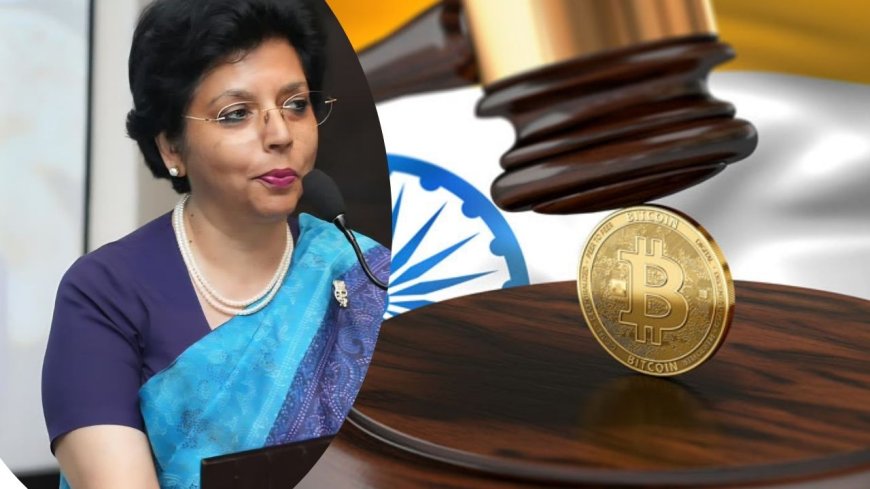
As the global cryptocurrency market surpasses $2.4 trillion, the policy debate around crypto-assets in India has shifted from questioning their legitimacy to determining how they should be effectively regulated. This was underscored by former Supreme Court judge Hima Kohli at the launch of the report “Crypto-Assets in India: Assessing the Case for Regulation”, prepared by Gujarat National Law University in collaboration with the Society of Indian Law Firms. The event was held at The Lalit Hotel, bringing together senior members of the judiciary, legal practitioners, policy experts, and representatives from the digital asset industry.
“Crypto assets illustrate the broader challenge that legal systems face when technological innovation evolves faster than legislative processes,” Justice Kohli said. She added that with India emerging as one of the largest markets globally, and millions of users participating in crypto trading and investment, the pressing question is no longer whether these technologies should exist but how they can be regulated responsibly.
India at a Regulatory Crossroads
The rapid adoption of digital assets in India has created a regulatory grey area. While the government has taken steps such as imposing taxation on virtual digital assets and extending anti-money laundering compliance obligations to crypto intermediaries, there remains no dedicated statutory framework governing these assets.
This lack of a comprehensive legal regime has implications for investors, exchanges, and technology developers, leading to uncertainty in areas ranging from compliance and taxation to cross-border transactions. Legal experts argue that such ambiguity can deter institutional participation and stifle technological innovation, potentially leaving India behind in the global Web3 ecosystem.
Justice Kohli highlighted that policymakers face a delicate balancing act: a regulatory framework must protect financial stability, ensure investor protection and transparency, while simultaneously allowing innovation in blockchain and digital technologies to continue unhindered.
Insights from the GNLU–SILF Report
The report, which is the culmination of a year-long research project by Gujarat National Law University and industry consultations across Bengaluru, Mumbai, and Delhi, presents a structured framework for crypto regulation in India.
It identifies five potential regulatory models, including:
- Single-regulator approach under the Reserve Bank of India (RBI) or Securities and Exchange Board of India (SEBI)
- Multi-regulator coordination with clear jurisdictional boundaries
- Self-regulation under government oversight until a robust statutory framework is established
Prof. (Dr.) S. Shanthakumar, Director of GNLU, said, “What began as a classroom discussion on a regulatory grey area eventually evolved into a national research initiative. The report provides policymakers with practical options to consider while shaping India’s approach to crypto regulation.”
Global Lessons and Comparative Models
- Loss of investor confidence
Justice Kohli stressed that India cannot treat crypto as a fringe technology. With millions of active users and growing institutional participation, “the task before policymakers is to craft a balanced framework that protects financial stability, ensures investor protection, and maintains transparency while supporting technological innovation,” she said.
The Way Forward
The report calls for a calibrated regulatory approach that combines:
Legal and policy experts agree that the sooner India establishes a comprehensive crypto regulatory framework, the better it will be positioned to compete globally while protecting domestic investors and ensuring financial stability.
Dr. Lalit Bhasin, President of SILF, remarked that the initiative demonstrates how academic research and stakeholder dialogue can inform policy on emerging technologies that are already shaping economic activity.
Conclusion
As digital assets continue to grow in scale and complexity, India stands at a critical crossroads. The GNLU–SILF report, combined with insights from legal luminaries like Justice Hima Kohli, provides a roadmap for policymakers to navigate the challenges of regulation.
The conversation has now shifted: it is no longer about whether crypto should exist, but about how law can create a safe, transparent, and innovation-friendly ecosystem for digital assets in India.
📌 Follow us on YouTube, Instagram, and Twitter for more updates.