AI Superpower or World’s Server Room? India’s Strategic Crossroads
Is India becoming an AI superpower or just the world’s server room? As global firms build AI infrastructure in India, the country provides land, power, and water, but ownership of algorithms, data, and profits remains largely external. Explore the economic and strategic stakes.
 Verdicto News Desk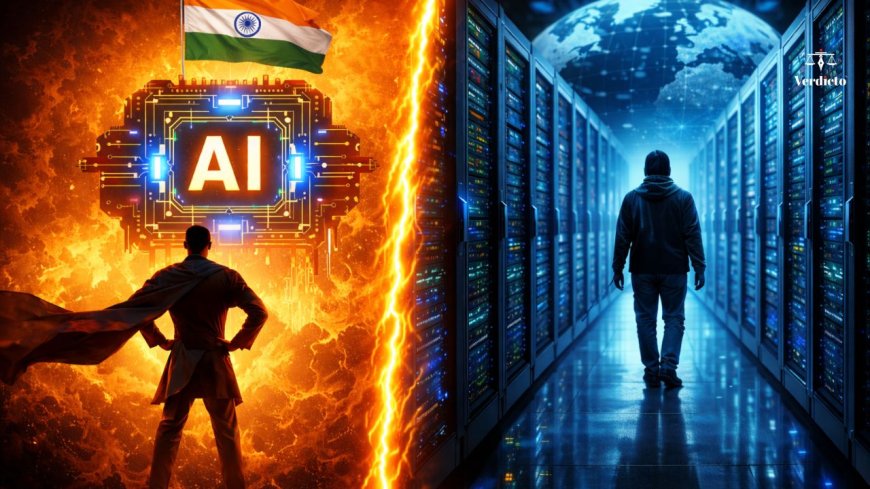
India is rapidly positioning itself as a global hub for artificial intelligence infrastructure. Data centres are expanding, global tech companies are scouting land, and policy discussions increasingly highlight India’s potential role in the AI economy. But a fundamental question is emerging: Is India building AI leadership or merely hosting the hardware that powers it?
AI Does Not Live in the Cloud
Despite the metaphor, artificial intelligence is deeply physical. Training and operating large AI systems requires:
- Vast tracts of land for data centres
- Continuous, low-cost electricity
- Massive quantities of water for cooling
- High-speed digital infrastructure
India offers all four at globally competitive costs. Affordable land outside major metros, relatively lower electricity prices in some industrial zones, and expanding renewable energy capacity make India attractive for AI infrastructure investment. For global firms, India can become a cost-efficient base to store data and run compute-heavy models.
But infrastructure ownership is not the same as technological leadership.
India’s Massive AI Investments
India’s tech ambitions are being built at an unprecedented scale. At this week’s India AI Impact Summit in New Delhi, Reliance Industries chairman Mukesh Ambani announced a $110 billion commitment to construct AI infrastructure across the country over the next seven years. This massive pledge is part of a broader coordinated effort, with Indian firms and the government collectively aiming to invest over $200 billion in AI infrastructure in the coming years. The stated goal is to make AI capabilities affordable and accessible to all, not just a privileged few, signaling India’s intent to be more than just a host for global AI servers.
The Value Chain Question
The AI economy has multiple layers:
- Infrastructure — land, power, cooling, servers
- Compute services — cloud and processing capacity
- Models and algorithms — intellectual property
- Applications and platforms — products that generate revenue
India is currently strongest in the first layer and competitive in the second. The highest value, however, lies in intellectual property and applications — where profits, market power, and global influence are concentrated.
If India provides physical infrastructure while foreign firms retain control over models, patents, and platforms, the economic structure begins to resemble a digital landlord arrangement: resources flow from India, but strategic control remains elsewhere.
Economic Gains vs Strategic Autonomy
Hosting AI infrastructure does bring benefits:
- Job creation in construction, operations, and maintenance
- Foreign investment inflows
- Expansion of digital infrastructure
- Potential boost to ancillary industries
However, long-term technological sovereignty depends on who owns the algorithms, data ecosystems, and platforms built on that infrastructure. Without domestic control over high-value AI development, India risks becoming essential to global AI supply chains but peripheral to decision-making power within them.
Legal and Policy Dimensions
This is not merely an economic question — it is a regulatory one.
Key legal-policy challenges include:
Data governance:
Who controls the data processed in Indian facilities? Data localisation alone does not ensure domestic value capture if processing rights and analytical outputs remain externally owned.
Intellectual property regimes:
If AI models are trained using Indian infrastructure and potentially Indian datasets, what share of IP value is retained domestically?
Environmental regulation:
Data centres consume large volumes of water and energy. The regulatory balance between industrial growth and ecological cost is a core governance challenge — particularly in water-stressed regions.
Competition policy:
Concentration of AI capability in a few global firms raises questions about market access for Indian innovators.
The Development Strategy Dilemma
India historically faced similar questions in manufacturing and natural resources:
Should the country prioritise investment inflows, or domestic capability building?
In the AI context, the dilemma is sharper because technological dependence can translate directly into economic and geopolitical dependence. A purely infrastructure-led strategy risks locking India into a low-value segment of a high-value industry.
A capability-led strategy would require:
- Public investment in compute capacity accessible to Indian researchers
- Incentives for domestic AI model development
- Strategic procurement policies favouring Indian AI applications
- Strong research ecosystems linking academia, industry, and state institutions
Beyond the “Landlord” Model
The real question is not whether India should host AI infrastructure — it almost certainly will. The question is whether infrastructure hosting becomes a stepping stone to technological leadership or an endpoint in itself.
If India supplies land, electricity, and water while others control algorithms, profits, and platforms, the country risks becoming the physical backbone of global AI without being its intellectual centre.
But if infrastructure expansion is paired with policy designed to nurture domestic innovation and ownership, India could transform hosting capacity into strategic leverage.
The Choice Ahead
India stands at a familiar but decisive crossroads:
resource provider or knowledge power.
The difference will not be determined by investment alone — but by regulation, institutional capacity, and long-term technological vision.
For a country that seeks global influence in the 21st century, the question is not whether AI infrastructure will be built in India.
The question is: Who will own the intelligence that runs on it?
📌 Follow us on YouTube, Instagram, and Twitter for more updates.