When "May" Is Not Enough: The Gap Between Advisory and Safety
A sharp analysis of the Supreme Court’s Vande Mataram advisory ruling, examining how “optional” state directives can turn into social coercion and affect fundamental rights.
 Verdicto News Desk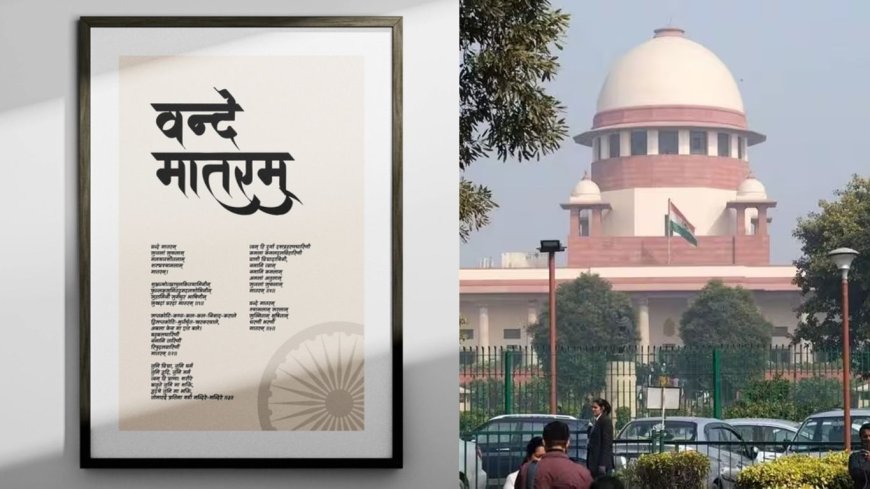
The Supreme Court's decision to dismiss the petition challenging the Centre's circular on singing Vande Mataram is, on its face, legally sound. The bench rested its reasoning on a single word: "may." Because the circular uses it rather than "shall," it remains advisory.
There is no penalty attached, nor are there any formal consequences for non-compliance. On that basis, the Court held the petition to be premature, granting the petitioner liberty to return if an actual instance of harm or coercion arises.
This is standard judicial reasoning. Courts are wary of ruling on hypotheticals. But the question raised during the hearing by senior advocate Sanjay Hegde deserves closer attention than the judgment ultimately gives it. What happens when an advisory begins to operate like an expectation? And when that expectation carries consequences, even if the law does not?
The word in the circular may say optional. The experience on the ground is rarely so clear-cut.
India has encountered this tension before. In Bijoe Emmanuel v. State of Kerala (1986), the Supreme Court upheld the right of three Jehovah's Witness children to stand respectfully during the national anthem without singing it, recognising that the right to remain silent is part of the freedom of expression under Article 19(1)(a).
The present case does not directly violate that principle. The circular does not mandate singing Vande Mataram. The Solicitor General's reference to Article 51A, which outlines the duty to respect national symbols, also carries weight. But that duty is not enforceable in the same way as a fundamental right. It guides conduct; it does not prescribe punishment. And notably, Vande Mataram does not occupy the same constitutional position as the national anthem. The distinction matters. But it is not where the real problem lies.
The difficulty is not in what the circular says, but in how such advisories function in practice. When the state signals, even gently, that a certain form of expression is desirable, it often creates a social expectation that exceeds the text itself. Institutions adopt it. Schools formalise it. Public spaces begin to treat it as routine. And the individual who opts out becomes visible in a way that is rarely neutral.
We have seen this before. In 2016, when the Supreme Court directed cinema halls to play the national anthem before screenings in Shyam Narayan Chouksey v. Union of India, the order did not explicitly invite enforcement by citizens. But what followed was numerous incidents where there was violence in one form or another towards people who were seen not to follow the directive.
In Goa, a man in a wheelchair was surrounded and physically assaulted by fellow audience members for not standing during the anthem. The incident was widely reported, not because it was exceptional, but because it was recorded. In the weeks and months that followed, similar confrontations were documented across multiplexes in several cities. People were heckled, threatened, and in some cases attacked. The Hindu reported assault cases in theatre halls. NDTV documented a pattern of vigilante enforcement spreading well beyond isolated incidents. These were not coordinated actions. They were the predictable result of a normative expectation taking hold in public spaces, one that the order itself had set in motion.
The Court later modified its position in 2018, making the playing of the anthem discretionary. The modification was itself an acknowledgement: the original direction had produced consequences its text never authorised.
That episode offered a lesson that the present case does not seem to have fully absorbed. Once an expectation around national symbols takes hold, enforcement does not remain confined to the state. It moves outward, often unpredictably, into the hands of the public.
That is the gap in the present case. The law draws a neat line between "may" and "shall." Social reality does not.
The Court's suggestion that affected individuals can return if they face discrimination reflects a familiar form of restraint. But it also assumes that those most likely to experience pressure will be in a position to seek a remedy. In practice, that is rarely the case. The burden falls on students, workers, and individuals in institutional settings, people for whom non-participation is not just a personal choice but a potentially risky one.
For them, the absence of a legal penalty offers limited reassurance. The cost is not always formal. It is social, reputational, and sometimes physical.
None of this is to suggest that the Court's reasoning is incorrect. It is consistent with established principles. But it leaves a major question unresolved, which is: when does an advisory stop being merely advisory?
Because in contexts shaped by identity, politics, and public display of patriotism, the difference between permission and expectation can be thin. And when that line blurs, the consequences are rarely hypothetical.
The law may continue to say "may." But for many, the choice will not feel like one.
The article is written by Utkarsh, a Ranchi-based journalist reporting on law, labour, and policy, with a focus on the intersection of rights and governance. His work has been featured in The India Forum and Feminism in India.