The Supreme Court and the Environment’s Double Edge
India’s Supreme Court shaped landmark environmental jurisprudence under Article 21, from forest protection to climate rights. But recent rulings on the Great Indian Bustard, Char Dham, and Great Nicobar reveal a growing tension between environmental justice and infrastructure development.
 Verdicto News Desk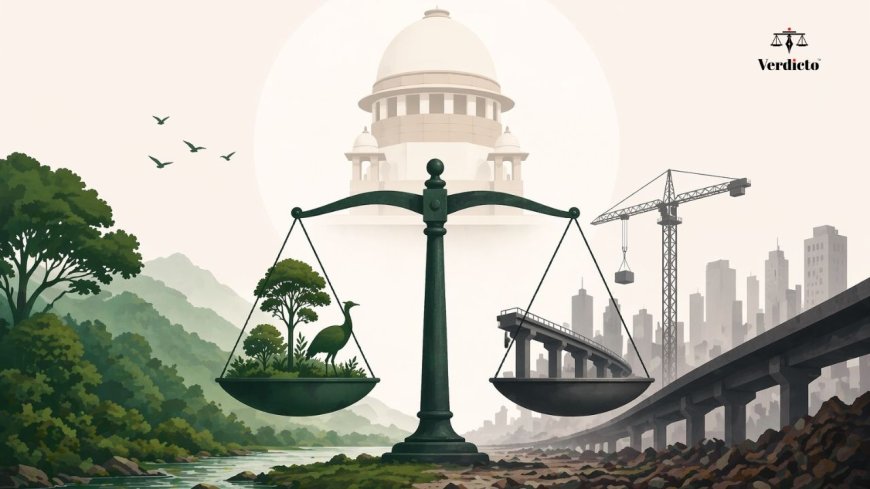
Over seven decades, India’s Supreme Court has built one of the world’s more remarkable bodies of environmental jurisprudence. It read the right to life under Article 21 to include the right to a clean environment, invented the continuing mandamus to monitor forest protection, and in 2024 went further still, recognising for the first time that the right to be free from the adverse effects of climate change is a fundamental right.
And then, in the same judgment, it approved solar transmission lines through the habitat of the critically endangered Great Indian Bustard, a bird with a population of fewer than 150.
That tension between the Court’s green rhetoric and its green record is not new. But it has sharpened considerably in recent years, as the scale and speed of infrastructure development have pushed the judiciary into increasingly difficult territory. The question worth asking is not whether the Court has been an environmental champion, because it has been, in patches. The question is whether the balancing act it now performs is tilting in a direction that undermines the very principles it helped establish.
A Legacy Worth Naming
T.N. Godavarman Thirumulpad v. Union of India is the longest-running case in the Supreme Court’s history. Filed in 1995 over illegal logging in the Nilgiris, it became the vehicle through which the Court extended protection to forests across the country, interpreting ‘forest’ broadly to include land recorded as such in government records, regardless of its current condition. The order effectively brought 1.97 lakh square kilometres of undeclared forest land under protection. Thirty years on, it remains active.
In March 2025, when the Telangana government began cutting over 400 trees in Kancha Gachibowli overnight, timed in a way that many noted coincided with a long festival weekend and minimised media attention, the Supreme Court moved quickly. It issued an interim stay on all tree felling, ordered a field inspection, and warned state officials of personal accountability for noncompliance. The Central Empowered Committee subsequently found that 60 to 70 per cent of the land qualified as medium-to-dense forest and that around 105 acres had already been illegally cleared. The Court’s rapid response is the kind of intervention on which its green legacy is built.
The 2024 judgment in M.K. Ranjitsinh v. Union of India was, in one part, genuinely historic. Anchoring the right against climate harm within Articles 14 and 21 placed India in rare company globally. It drew from international jurisprudence the Dutch Urgenda case, the UNFCCC framework and Chief Justice Chandrachud observed that without a stable, clean environment, the right to life cannot be fully realised.
These are not small things. They represent decades of judicial creativity in the absence of explicit constitutional text and, often, in the face of executive indifference.
Where the Record Gets Complicated
The same Ranjitsinh judgment that declared climate protection a fundamental right then approved overhead power lines through the Great Indian Bustard’s last remaining habitat, reasoning that renewable energy projects served climate justice goals. Environmental experts have questioned the logic. The Bustard has not recovered.
The Char Dham highway project has become one of the most documented cases of the gap between judicial oversight and on-ground reality. The Court appointed a High-Powered Committee chaired by environmentalist Ravi Chopra to assess the project’s ecological impact on 825 kilometres of Himalayan highway. The HPC submitted its findings. The government argued for strategic importance. The Court, ultimately, sided with a wider road configuration. Chopra resigned in 2022, warning the mountains were being pushed toward a catastrophic tipping point. In 2022 alone, more than 300 landslides were recorded along the 250-kilometre stretch between Rishikesh and Joshimath. In 2023, the Silkyara tunnel collapsed, trapping 41 workers.
In August 2025, Uttarakhand’s forest department approved 17.5 hectares of forest land for a new Char Dham bypass in the Bhagirathi eco-sensitive zone, a zone where the Supreme Court had capped road width at 5.5 metres in its 2020 order. Local activists wrote that the approval amounted to contempt of court. Work continued regardless.
Great Nicobar is the more recent and starker case. The Rs 81,000-crore project would divert 130 square kilometres of tropical forest and fell close to a million trees on one of India’s most biodiverse islands, home to the critically endangered leatherback turtle and the Shompen, a Particularly Vulnerable Tribal Group. More than 70 experts, former bureaucrats, and environmentalists wrote an open letter to the Environment Minister urging a halt. The National Green Tribunal, in February 2026, found ‘no good ground to interfere’ with the environmental clearance, citing the project’s strategic importance. The Galathea Bay Wildlife Sanctuary, designated in 1997 specifically for leatherback turtle conservation, had already been denoted in 2021 to make way for the port. The challenge to forest clearances is pending before the Calcutta High Court. Groundwork, meanwhile, continues.
The Philosophy That Is Shifting
The legal framework that made early SC environmental judgments powerful rested on two principles: the precautionary principle and the polluter pays doctrine, both codified in Vellore Citizens Welfare Forum v. Union of India (1996). In Vellore, the Court was categorical: when there is uncertainty about environmental harm, the burden falls on those proposing the activity to prove safety, not on the public to prove damage.
That logic has not been formally abandoned. But it has been diluted in practice. The shift toward ‘sustainable development’ as a balancing concept has, in several recent cases, meant that the project proponent gets the benefit of the doubt when strategic or national interest is invoked. The Great Indian Bustard case, the Char Dham judgment, and the trajectory of the Nicobar clearances all reflect a reading where development need not be stopped but merely managed and monitored.
As one analysis of the Court’s environmental record noted in Supreme Court Observer, the dominant theme running through the Court’s approach is consistent with the idea that nature on itself, that is, without the usefulness to human development, has any intrinsic worth. That position was defensible in an era of smaller ecological stakes. It is harder to defend when the Himalayan slopes are sliding, and a species is down to its last 150 members.
There is also a structural concern. The 2023 amendment to the Forest Conservation Act sought to narrow the Godavarman definition of ‘forest’ by excluding borderland regions and areas affected by Left-wing extremism patches that frequently overlap with dense forest and tribal land. The SC has directed states to follow the Godavarman definition for now, but the legislative intent is clear.
What the Ground Shows
The problem is not only in court orders. It is in the chain between an order and what happens on the ground. The Char Dham project was divided into 53 smaller components to avoid a comprehensive Environmental Impact Assessment. Forest clearances were obtained based on approvals from 2002 and 2012, not fresh ones for the actual project. Also, the Uttarakhand forest department allowed tree-felling without having any compliance report.
In Kancha Gachibowli, the expert committee that should have completed its forest survey before any felling was only constituted two weeks before the bulldozers arrived. No survey was completed. No environmental clearance was sought. In Nicobar, compensatory afforestation for one of the world’s richest tropical rainforests is being planned in Haryana and Madhya Pradesh, a substitution that experts describe as ecologically meaningless.
The pattern is not a coincidence. It reflects what happens when monitoring is post-hoc, penalties are low, and the pressure to deliver infrastructure is high. Judicial orders create the appearance of oversight without the mechanisms to make oversight real.
Four Things That Would Actually Help
Restoring the precautionary principle as the genuine default, not a principle to be cited and then balanced away, would mean that when expert committees flag serious ecological risk, that finding triggers a presumption against clearance, not a trigger for further negotiation.
Independent expert panels, appointed by the Court rather than drawn from the same ministry ecosystem that processes clearances, are the obvious structural fix. The HPC in Char Dham was one such body. The government’s response to its findings, overriding its core recommendations by invoking strategic importance, shows why insulation from executive pressure matters.
Mandatory post-clearance audits, at six-monthly intervals, with findings reported directly to the court in continuing matters, would change the accountability calculus. Right now, conditions attached to clearances are largely unverified. The Great Nicobar clearance came with thirty years of promised conservation monitoring. There is no mechanism, currently, to enforce that promise.
Finally, Environmental Impact Assessments need to clearly assess climate risks like rising sea levels as a basic requirement, not an afterthought. Building a port in a fragile, protected area without properly considering these risks is not just an environmental lapse. It is poor planning.
What Is Actually at Stake
The Supreme Court’s environmental legacy is real, and it matters. Godavarman, Vellore, and Kancha Gachibowli represent genuine institutional courage at moments when the executive showed none. The problem is that the legacy is being spent faster than it is being replenished.
Article 21 cannot simultaneously mean the right to be free from climate harm and the right of the state to override expert committees and clear projects in biosphere reserves by invoking strategic importance. One of these interpretations will, over time, hollow out the other. The Himalayan slopes, the Galathea Bay turtles, and the Shompen are not abstractions. They are the ground reality of what the balancing act currently produces.
The Court has the jurisprudential tools to do better. The question is whether it will use them.
The article is written by Utkarsh, a Ranchi-based journalist reporting on law, labour, and policy, with a focus on the intersection of rights and governance. His work has been featured in The India Forum and Feminism in India.