Supreme Court Seeks Data on UAPA, NDPS Cases; Pushes for Special Courts Across India
The Supreme Court has directed states and UTs to submit data on pending UAPA and NDPS cases, pushing for exclusive special courts to ensure faster trials and timely justice in terror and narcotics-related matters.
 Verdicto News Desk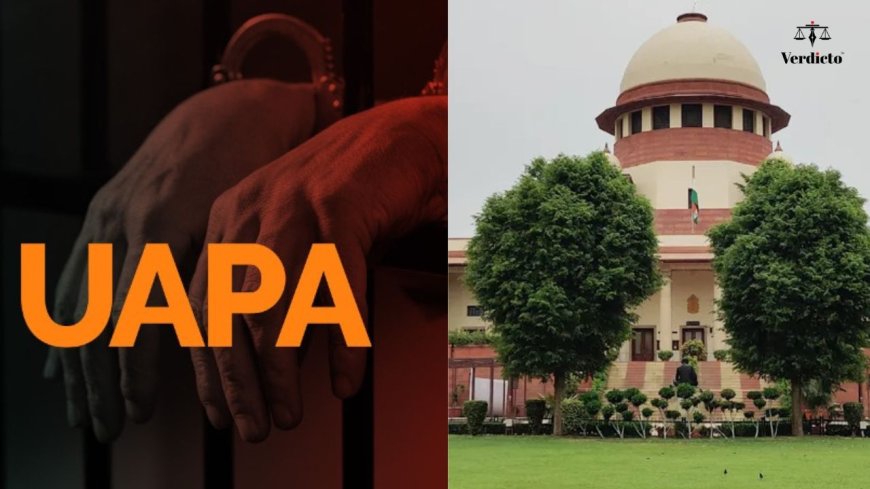
The Supreme Court has taken a significant step to expedite the disposal of pending cases related to terrorism and narcotics. The Court has directed all states and Union Territories to submit comprehensive data on cases registered under the Unlawful Activities (Prevention) Act (UAPA) and the Narcotic Drugs and Psychotropic Substances (NDPS) Act.
The directive covers cases investigated by various agencies, including the National Investigation Agency (NIA), Narcotics Control Bureau (NCB), state police, and other authorities. The objective is to assess the need for establishing dedicated and exclusive special courts to ensure faster trials.
A bench comprising Chief Justice Surya Kant and Justice Joymalya Bagchi also asked the central government to consider providing financial assistance of ₹1 crore per court for setting up such courts across states and Union Territories. Additionally, the Court suggested an annual grant of up to ₹1 crore for the effective functioning of these courts. The matter is scheduled for the next hearing on May 8.
Earlier, on March 24, the Supreme Court had directed the establishment of special courts for cases investigated by the NIA and those under the UAPA. The Court has now expanded the scope to include NDPS cases as well. It emphasized that timely disposal of such cases is crucial to safeguard the rights of the accused while ensuring that victims receive justice without undue delay.
The Court has specifically sought information from the Advocates General of 17 states, including Delhi, Maharashtra, Gujarat, Bihar, and Jammu & Kashmir, where the number of pending cases remains high. It noted that in several instances, judges of special courts are assigned additional responsibilities, which adversely affects the hearing of NIA and UAPA cases. The bench made it clear that NIA courts should exclusively handle UAPA and related matters.
According to a January 7, 2026 office memorandum issued by the Ministry of Home Affairs, a financial framework has already been outlined for these courts. It includes annual grants of up to ₹1 crore for staff salaries and operational expenses, along with a one-time allocation of up to ₹1 crore for infrastructure, IT equipment, and furniture. The Court also urged Chief Justices of respective High Courts to expedite the appointment of experienced judges for these courts.
Key Highlights:
- Supreme Court seeks detailed data on UAPA and NDPS cases from all states and UTs.
- Centre asked to consider ₹1 crore setup cost and annual operational funding per special court.
- Push for pilot-based establishment of exclusive courts in 17 states with high case pendency.
📌 Follow us on YouTube, Instagram, and Twitter for more updates.