Did the Election Commission Change the Voter Registration Form? What the Supreme Court Has and Hasn't Said
Who is right on Form 6? The Court says it approved no changes; the Election Commission says its declaration was upheld. The judgment settles only part.
 Verdicto News Desk
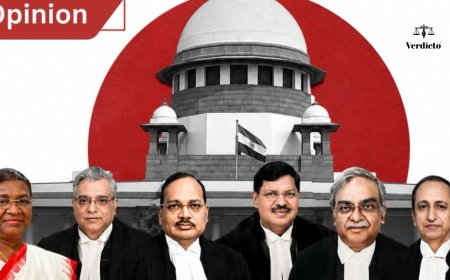
the Supreme Court said it has not approved any modification to Form 6, the application a person uses to seek inclusion in the electoral roll. A bench of Chief Justice Surya Kant and Justices Joymalya Bagchi and V Mohana said, "Any modification to Form 6 has not been approved by us," and added that once records are produced, it would like to see who modified it. The remark came while the bench issued notice on a public interest litigation about the Election Commission of India's (EC) Special Intensive Revision (SIR) of electoral rolls. It is a statement about what the Court has approved. It is not a finding about what the Commission has done.
The reason the remark drew attention is a statement the Commission made earlier. The Commission said the declaration attached to Form 6 for SIR had been upheld by the Supreme Court in its order of 27 May 2026. PTI reports that the Commission's press release of 26 September suggested the Court had upheld the Form 6 declaration in its May 2026 judgment on the Bihar SIR. The Commission's claim is about a declaration annexed to the form. It does not say the form itself was changed, and the Court's remark does not say it was. Whether the two statements conflict depends on what the Court actually decided in May.
The judgment, reported as 2026 INSC 564 in Association for Democratic Reforms v. Election Commission of India, gives the Commission some support. In paragraph 152, the Court says Form 6 as prescribed under the Registration of Electors Rules, 1960, is tailored to the revision contemplated under Section 21(2) of the Representation of the People Act and may not be capable of literal application to an SIR. The Commission therefore retains "a degree of residual authority" to frame a documentation regime suited to an SIR. Paragraph 158 adds that the Commission's discretion is not wholly confined by Rules 4 to 23 of the 1960 Rules, and that it may substitute documents listed in Form 6 with other classes of document.
The same paragraph 152 also limits that authority. It says the authority is not unbounded, that the Commission must remain cognisant of the existing statutory scheme, and that any departure from it must have a rational nexus to the object sought to be achieved. And both paragraphs concern the documents an applicant must produce. The Annexure D declaration is mentioned in the judgment only in paragraph 45, where the Court summarises the Commission's order of 24 June 2025 and notes that a new voter had to submit Form 6 along with a Declaration Form in Annexure D. In the text reviewed, the Court does not examine what that declaration asks or hold it valid. The judgment is also dated 27 May, so it cannot have considered anything introduced after that date.
The petition, filed by Shailendra Mani Tripathi and argued by senior advocate Maneka Guruswamy, alleges that a requirement relating to the applicant's ancestry and a link to the previous SIR was introduced through the Commission's software without the statutory amendment the electoral rules require. It says the other two Election Commissioners objected. These are the petitioner's allegations, and the Court has made no finding on them. The Commission, for its part, has said that all SIR orders received the unanimous consent of all three Commissioners.
That dispute is why the petition invokes the Chief Election Commissioner and Other Election Commissioners Act, 2023. It relies on Section 18, which, as the plea describes it, provides that where opinions differ, the majority view prevails. The petition argues that decisions taken by Chief Election Commissioner Gyanesh Kumar without his colleagues' concurrence are unconstitutional, ultra vires and void. It also seeks criminal proceedings against the CEC and other officials. The bench told the petitioner's counsel that the prayers appear jumbled. The plea further alleges that the software lacked a feature to restore 97 eligible electors in Goa, and that in West Bengal more than 16.10 lakh appeals were filed in the EC's name against voters whose names judicial officers had restored, without the knowledge or authorisation of the other two commissioners and the state's chief electoral officer. None of this has been tested.
The Court has issued notice and tagged the matter with another PIL, filed by Patna resident Rakesh Kumar Singh, on the same issue. The Commission's response and its records will address two questions: who authorised the declaration, and whether the three Commissioners decided together.