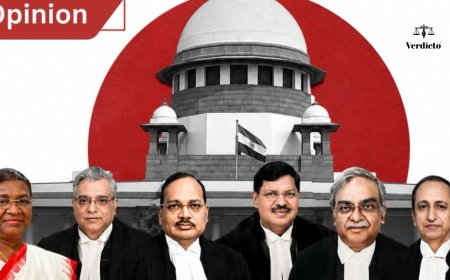
Why Ex-Judges' Benefits Vary by State — And Why the SC's New Panel Faces an Uphill Task
Supreme Court orders Centre to form a panel within two weeks on uniform post-retirement benefits for retired high court judges. An analysis of the federalism, fiscal, and Article 221 questions the SC's new committee must navigate.
 Verdicto News Desk
New Delhi, July 20: The Supreme Court's direction to the Centre on Monday to constitute a committee for evolving a uniform national policy on post-retirement benefits for former high court judges brings before the constitutional courts a problem that has persisted at the intersection of judicial independence, federal fiscal arrangement, and administrative discretion for decades.
The bench of Chief Justice of India Surya Kant, and Justices Joymalya Bagchi and V Mohana, was hearing a contempt petition instituted by Justice V S Dave, President of the Association of Retired Judges of the Supreme Court and High Courts, concerning the adequacy and consistency of facilities such as security personnel, drivers, domestic help, telephone connections, medical reimbursement, and continued occupation of government accommodation extended to retired Chief Justices and judges of high courts across states.
The core of the dispute is not novel in constitutional terms, but its persistence reveals a structural gap in how service conditions for the higher judiciary are governed once a judge demits office. Article 221 of the Constitution empowers Parliament to determine the salaries, allowances, and conditions of service of judges of the high courts, and by extension has historically been read to extend to pensionary and post-retirement matters through the High Court Judges (Conditions of Service) Act, 1954, and successive amendments. However, several ancillary benefits, particularly those relating to security cover, drivers, and residential retention, have in practice been left to executive discretion at the state level, since state governments bear the administrative and financial burden of extending many of these facilities even though the judges in question served courts that are constitutionally federal in character, exercising jurisdiction that is not confined to any single state. This has produced precisely the disparity the Court noted on Monday: a former Chief Justice or judge in one state may receive a materially different quantum of security or logistical support than a counterpart who served an equivalent tenure in another state, despite both having discharged functions of identical constitutional stature.
The CJI's exchange with Solicitor General Tushar Mehta is instructive because it surfaces the practical inadequacy of existing allowances. The reference to a monthly assistance figure in the range of Rs 45,000 to Rs 50,000 being insufficient to engage both a driver and a security officer is not merely a rhetorical flourish; it points to a real erosion in the value of fixed allowances that have not kept pace with prevailing wage costs for private security and driving personnel, particularly in metropolitan centres. This is a familiar pattern in Indian public service jurisprudence, where allowances fixed at a point in time are not indexed or periodically revised, resulting in benefits that are nominally intact but substantively hollowed out. The Court's suggestion that the Union government could constitute a norm-setting committee, potentially coupled with matching central grants to states, reflects an attempt to address this through a cooperative federalism mechanism rather than through unilateral judicial fiat, at least in the first instance.
The Solicitor General's response, that the government has no difficulty constituting such a body and will address the matter "in the spirit expressed," is a familiar formulation in cases where the executive is disinclined to resist a direction issued from the bench but equally disinclined to make binding commitments in open court. The Court's order, however, does not leave this to informal assurance. It fixes a two-week timeline for constitution of the panel and a further three-month timeline for the panel's report, which converts what might otherwise have remained an aspirational observation into an enforceable directive with a contempt petition already on the record as the underlying proceeding. This procedural posture matters: because the matter arises out of a contempt petition rather than a fresh writ petition, the Court retains supervisory jurisdiction over compliance in a manner that carries a lower threshold for future coercive action should the Centre fail to meet the timelines it has now accepted before the bench.
Substantively, the Court's characterisation of the issue, that facilities for retired Chief Justices and judges of high courts vary considerably from state to state and that this absence of uniformity has itself been the proximate cause of the litigation, positions this as fundamentally a question of equal treatment among similarly placed constitutional functionaries rather than a claim for enhanced privilege. That framing is significant for how the eventual committee report is likely to be received. A policy grounded in parity across states, rather than in an upward revision of benefits as such, is less susceptible to public criticism of the judiciary extending privileges to itself, and more easily defensible as a rationalisation of an already-existing entitlement structure.
The Centre's acknowledged role as a vital stakeholder, particularly given that any uniform framework will likely require Union financial participation to induce compliance from states with weaker fiscal capacity, also signals that the eventual policy is unlikely to take the form of a purely advisory circular. Matching grants, if adopted, would create a financial incentive structure similar to centrally sponsored schemes, whereby uniformity is achieved not through a constitutional mandate compelling states, but through the Centre absorbing a portion of the marginal cost of compliance. This is consistent with the broader pattern by which service conditions for constitutional functionaries that fall outside strict Article 221 salary and pension guarantees have historically been harmonised: through negotiated administrative frameworks rather than legislative amendment, given the practical difficulty of amending the 1954 Act or analogous central legislation to specifically prescribe security and logistical benefits with the granularity the present dispute demands.
The uphill task facing the committee is not merely one of drafting a uniform schedule of benefits, but of reconciling that schedule with the fiscal federalism realities that produced the disparity in the first place. States with larger revenue bases have historically been more generous in extending discretionary facilities to retired judicial officers, while states with tighter fiscal constraints have treated such benefits as a lower budgetary priority relative to competing claims. A central norm without a corresponding central financing mechanism risks becoming an unfunded mandate that states resist in practice even where they accept it in principle, a pattern well documented in other centrally driven uniformity exercises, from police modernisation schemes to judicial infrastructure grants under the Centrally Sponsored Scheme for the Development of Infrastructure Facilities for the Judiciary. Whether the committee, once constituted, will succeed in producing a workable uniform framework within the three-month window set by the Court therefore depends less on the substantive content of the eventual policy and more on whether the Centre is prepared to underwrite a meaningful share of its cost, particularly given that previous attempts to harmonise judicial service conditions across states have often stalled at the stage of interdepartmental consultation between the Ministry of Law and Justice, the Ministry of Home Affairs on matters of security protocol, and respective state governments.
The Court's retention of supervisory control through the underlying contempt proceeding distinguishes this attempt from earlier informal efforts, and gives the Association of Retired Judges a continuing procedural avenue to return to the bench should the Centre's timeline slip. For an institution whose retired members continue to be called upon for commissions of inquiry, tribunal appointments, and arbitration, the adequacy of post-retirement security and logistical support is not merely a service condition but bears on the institutional dignity accorded to judicial office after demission, a concern the Court appears to have treated as sufficiently weighty to move from observation to binding timeline in a single hearing. Whether that urgency survives the committee process, given the interdepartmental and fiscal federalism obstacles that have frustrated comparable efforts before, is the question the next three months will answer.