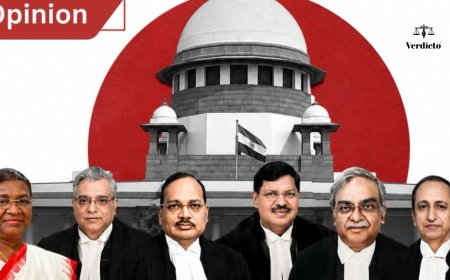
Justice Yashwant Varma Cash Row: Resignation May End Impeachment, But Not Criminal Accountability, Says Mathews Nedumpara
Justice Yashwant Varma cash row: Advocate Mathews J. Nedumpara discusses FIR, the inquiry committee report, resignation and criminal accountability in an exclusive Verdicto interview.
 Verdicto News Desk
New Delhi, Aug 14: The inquiry into the allegations surrounding cash reportedly found at the official residence of Justice Yashwant Varma has reached a crucial stage, but questions of accountability remain unresolved.
The three-member committee constituted to examine the allegations has concluded that the charges against Justice Varma were proved. However, Justice Varma had already resigned from office, raising a fundamental question: what, if anything, can follow once impeachment proceedings have effectively lost their purpose?
In an interview with Verdicto, Advocate Mathews J. Nedumpara, who had called for registration of an FIR in the matter at an early stage, argued that resignation cannot by itself answer the question of possible criminal accountability.
“The FIR should have been registered”
Asked whether an FIR could still be registered, Nedumpara was unequivocal.
According to him, the police should have registered an FIR when the alleged recovery of cash was first brought to their notice. He rejected the idea that registration of an FIR should necessarily have awaited prior permission from the Chief Justice of India.
His argument rests on a basic distinction: registration of an FIR and prosecution are not the same stage of a criminal proceeding.
For Nedumpara, the police have a separate constitutional and statutory role in investigating alleged offences, and that role should not be confused with the institutional mechanisms applicable to members of the higher judiciary.
He also stressed the principle that criminal law must apply equally to everyone.
Inquiry is not the same as criminal investigation
A significant part of the interview concerned the legal nature of the committee's proceedings.
Nedumpara drew a sharp distinction between investigation, inquiry and adjudication.
In his view, the inquiry conducted by judicial or parliamentary mechanisms cannot substitute for a criminal investigation by the police. The collection and examination of evidence in a criminal case, he argued, is ultimately the responsibility of the investigating agency.
That distinction becomes particularly significant in the Justice Verma case because the inquiry committee's findings and a possible criminal investigation would serve different purposes.
The committee's conclusion may have consequences within the constitutional process concerning judicial accountability. But whether any criminal offence was committed, who may be responsible, and whether a prosecution should follow are questions that, in Nedumpara's view, require a proper police investigation.
What does resignation change?
Justice Verma's resignation fundamentally changed the constitutional position of the proceedings against him.
Nedumpara's view is that the resignation brings the impeachment process to an end and leaves the committee report with essentially academic significance in that context.
But he does not consider that the end of the impeachment process necessarily exhausts every possible consequence arising from the allegations.
That is where he draws the distinction between institutional accountability and criminal accountability.
As he put it during the interview, a case can have criminal consequences, and those consequences would require an FIR and a subsequent investigation.
The question, therefore, is no longer simply whether Justice Verma can be removed from office. He has already resigned.
The more difficult question is whether the allegations can now be subjected to an independent criminal investigation.
“I will move an FIR now”
Asked directly whether he would pursue the FIR, Nedumpara said he would.
He stressed that his position was not driven by any personal animosity towards Justice Verma. Instead, he presented it as a question of the application of law irrespective of the status of the individual involved.
His position also reflects the larger argument he made throughout the interview: judicial office, while carrying important institutional protections, cannot place an individual above the law.
The distinction is crucial. Judicial independence protects judges from interference in the discharge of their judicial functions. It does not, in Nedumpara's formulation, mean that allegations of criminal conduct should simply disappear because the individual holds or once held judicial office.
The accountability question remains
The Justice Verma controversy now presents an unusual legal and constitutional situation.
The institutional process has produced a finding that the allegations examined by the committee were proved. The judge has resigned. The impeachment route is therefore no longer capable of producing the same consequence it was designed to produce.
Yet the central criminal-law question remains separate: was an offence committed, and if so, will there be a police investigation?
Nedumpara's answer is that the matter should not end with the resignation.
For him, the issue ultimately comes down to equality before law.
“Nobody,” he argued during the interview, “because of the position he enjoys, should be above the law.”
That leaves the next chapter of the Justice Verma controversy outside the impeachment process — and potentially in the hands of the criminal justice system.
The full conversation with Advocate Mathews J. Nedumpara is available on Verdicto.