AI No Longer a Speculative Technology but an Operational Reality, Says CJI Surya Kant
Chief Justice of India Surya Kant says artificial intelligence is now an operational reality posing major challenges for international law, governance, sovereignty, accountability, and judicial systems.
 Verdicto News Desk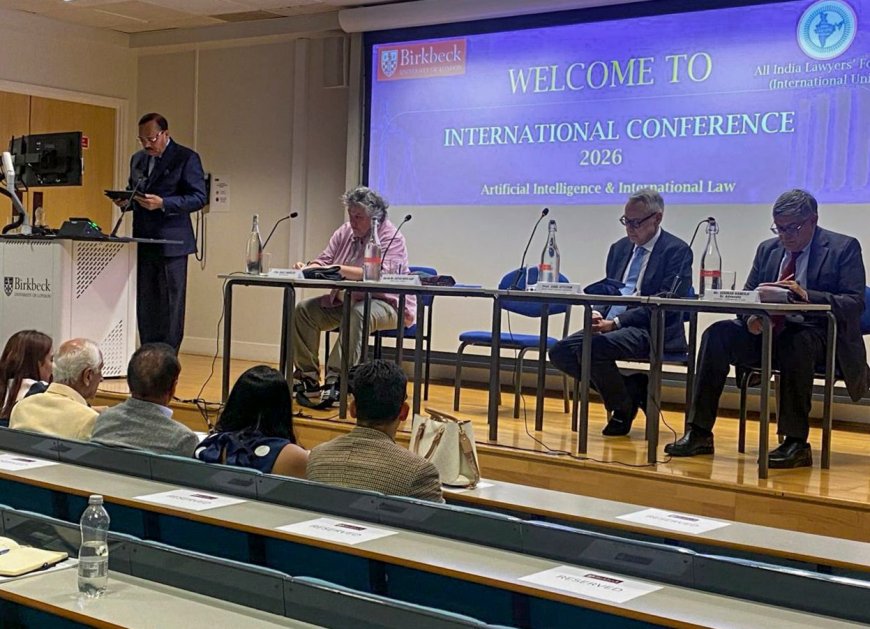
Chief Justice of India (CJI) Surya Kant has said that artificial intelligence (AI) is no longer a futuristic or speculative concept but an operational reality that is rapidly transforming governance, commerce, warfare, public administration, and even the exercise of judicial power.
Delivering a public lecture on "Artificial Intelligence and International Law" at Birkbeck College, University of London, the Chief Justice described AI as one of the most significant challenges confronting international law in the modern era. He cautioned that decisions taken by governments and legal institutions during this decade would shape the future relationship between technology, power, freedom, and justice for generations.
Technology Must Remain Accountable to Constitutional Values
Emphasising that technology itself is neither inherently beneficial nor harmful, Justice Kant said its impact depends on the legal, political, and ethical frameworks within which it is deployed.
"The responsibility of law is neither to resist technological progress nor to surrender unquestioningly before it," he said, adding that legal systems must ensure technological power remains accountable to constitutional values, democratic legitimacy, and human dignity.
AI's Expanding Role in Governance
Highlighting the growing influence of AI in public decision-making, the Chief Justice noted that governments worldwide are increasingly relying on algorithmic systems for welfare distribution, immigration assessments, border management, financial regulation, and policing functions.
He also pointed to the rapid development of autonomous military technologies and the increasing number of legal disputes involving AI-generated evidence, automated decision-making, and digital due process.
According to Justice Kant, private technology corporations today possess informational capabilities that in some cases rival those of sovereign states, raising complex questions about accountability and regulation.
Opportunities for the Justice System
While acknowledging the risks posed by AI, the Chief Justice also underlined its potential to strengthen judicial administration.
He observed that courts across various jurisdictions are already using AI-powered tools for legal research, case management, translation, transcription, document classification, and identifying relevant judicial precedents.
"When deployed responsibly and under appropriate human supervision, AI can reduce delays, improve efficiency, and expand access to justice," he said.
Justice Kant stressed that such technologies should not be viewed solely as sources of legal complexity but also as instruments capable of advancing the constitutional promise of timely and effective justice.
Can International Law Keep Pace?
A central theme of the lecture was whether existing principles of international law are equipped to regulate the rise of artificial intelligence.
The Chief Justice questioned whether foundational doctrines such as sovereignty, human rights, and the enforceability of international legal obligations can adequately adapt to govern algorithmic power.
"The real question is not whether AI will influence international law—the transformation is already underway. The question is whether international law possesses the conceptual flexibility necessary to absorb this disruption," he said.
Challenge to Traditional Notions of Sovereignty
Justice Kant noted that traditional international law is deeply rooted in territorial boundaries, whereas AI systems often operate through globally distributed networks that transcend national borders.
He explained that an AI model may be trained using data collected from multiple countries, processed through infrastructure located elsewhere, deployed via cloud systems spanning continents, and ultimately affect individuals far removed from any single jurisdiction.
Such cross-border operations, he said, complicate questions of legal responsibility, regulatory oversight, and jurisdiction.
Preserving Accountability in the Age of Algorithms
Concluding his address, the Chief Justice emphasised the need for sustained dialogue between courts, governments, academic institutions, and civil society to address the legal and ethical challenges posed by artificial intelligence.
"The future of artificial intelligence will be shaped not only by innovation but by the legal and moral choices humanity collectively makes," he said.
He warned that the international community's task extends beyond regulating technological capability to preserving legal responsibility in environments increasingly shaped by algorithmic decision-making.
"If responsibility becomes too fragmented to identify, accountability itself risks becoming illusory," the Chief Justice observed.
Justice Kant is currently on a six-day visit to the United Kingdom.