Who Decides a Hunger Striker's Medical Treatment? Wangchuk Case Explained
Delhi HC petition on Sonam Wangchuk's hospitalisation raises key legal questions on Article 21, medical custody, and state power over a hunger striker's treatment.
 Verdicto News Desk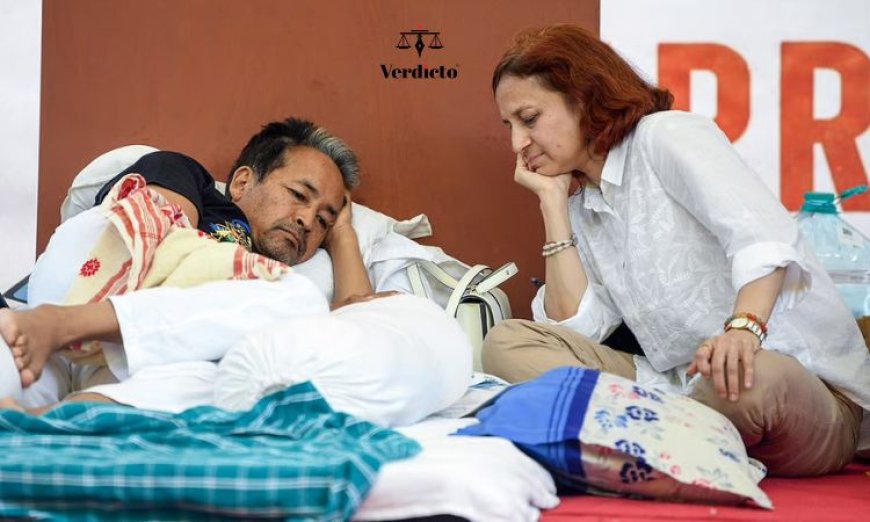
New Delhi, July 19: The petition filed by Gitanjali J Angmo before the Delhi High Court, seeking to shift her husband Sonam Wangchuk from Safdarjung Hospital to a private facility of her choosing, brings into sharp focus a question Indian courts have never fully settled: once the state takes custody of a hunger-striking activist's body in the name of medical necessity, who retains the authority to decide how that body is treated, and by whom.
The immediate legal issue is narrower than it appears. Angmo's plea does not ask the court to rule on the legality of hunger strikes as a form of protest, nor does it challenge the state's power to intervene medically when a person's life is at risk. What it challenges is the manner and locus of that intervention: whether Wangchuk's forcible removal from Jantar Mantar, his continued hospitalisation at a government facility against his family's wishes, and the restriction of independent medical access to him, together amount to a deprivation of personal liberty that exceeds what the July 16 order actually authorised.
That distinction matters because the July 16 order itself was passed ex-parte, without Wangchuk or his representatives present to contest its terms. Ex-parte directions of this kind are ordinarily narrow and provisional by design, intended to authorise monitoring and, if necessary, medical intervention, not to function as a standing warrant for whatever measures the authorities subsequently consider expedient. Angmo's petition argues that the police used this order as cover for an action, the forcible removal of a fasting man from a protest site absent any medical emergency, that the order's language does not fairly support. Should the court find that the police extended the order beyond its actual scope, the forcible removal itself becomes legally infirm, independent of whether hospitalisation was otherwise justifiable.
This is where Article 21 enters directly. The right to life and personal liberty has been read by the Supreme Court to include the right to refuse medical treatment and to make decisions about one's own body, subject to the state's countervailing interest in preventing loss of life. Indian courts have historically permitted the state to intervene to prevent a hunger striker's death, treating the preservation of life as a legitimate limitation on individual autonomy. That doctrine, however, has generally concerned the state's power to feed or treat a person against their will when death is imminent; it has not been read to extend to the state's power to dictate which hospital, which doctors, or which family-authorised second opinion a person is entitled to once in custody. Angmo's petition is built on precisely this gap: she does not contest that Wangchuk may need medical care, she contests Safdarjung's exclusive control over what that care consists of and who may verify it.
The discrepancy in Wangchuk's potassium test results, as alleged in the petition, is not a peripheral detail but central to the legal argument. If a government hospital's disclosed clinical figures diverge materially from an independent laboratory's findings on the same blood sample, taken the same day, the reliability of the hospital's medical justification for continued detention becomes a matter the court can properly interrogate. Indian courts, including in cases concerning custodial health and forced hospitalisation, have shown a willingness to order independent medical boards or permit family-nominated doctors precisely when the state's own account of a person's condition is disputed on credible grounds. The alleged ten-and-a-half-hour delay in providing the blood sample compounds this, since unexplained delay in disclosure has itself been treated by courts as relevant to an inference of non-transparency, even where it does not establish deliberate manipulation.
There is also a narrower procedural question the high court will need to weigh: whether the scale of the police presence described in the petition, some thirty personnel on Wangchuk's floor and over a hundred across the hospital, is itself a form of continued restraint that converts what is nominally medical custody into something closer to detention. Courts distinguish between protective monitoring, which may justify a police presence to prevent a patient from leaving against medical advice, and a deployment whose scale suggests the state is treating a hospitalised individual as being in custodial confinement rather than under care. Should the court find the latter, questions of habeas corpus, and not merely medical transfer, could come into play, since Angmo's petition already frames the hospitalisation as "illegal detention" rather than treatment.
What the Delhi High Court ultimately decides will turn on how it reads the boundary between the state's legitimate power to preserve the life of a hunger striker and a family's right, once that power has been exercised, to choose the terms of ongoing care. The July 16 order gave the state authority to intervene. It did not, on its face, resolve who controls the intervention once it has occurred. That is the question now squarely before the court, and its answer will shape not only the outcome for Wangchuk but the precedent for how far medical custody of a protesting individual may extend before it becomes something the Constitution does not permit.