Will increasing the Supreme Court's strength solve India's justice delivery crisis?
Will increasing the Supreme Court's judge strength reduce judicial pendency? An analysis of why India's backlog of cases requires structural reforms beyond appointing more judges.
 Verdicto News Desk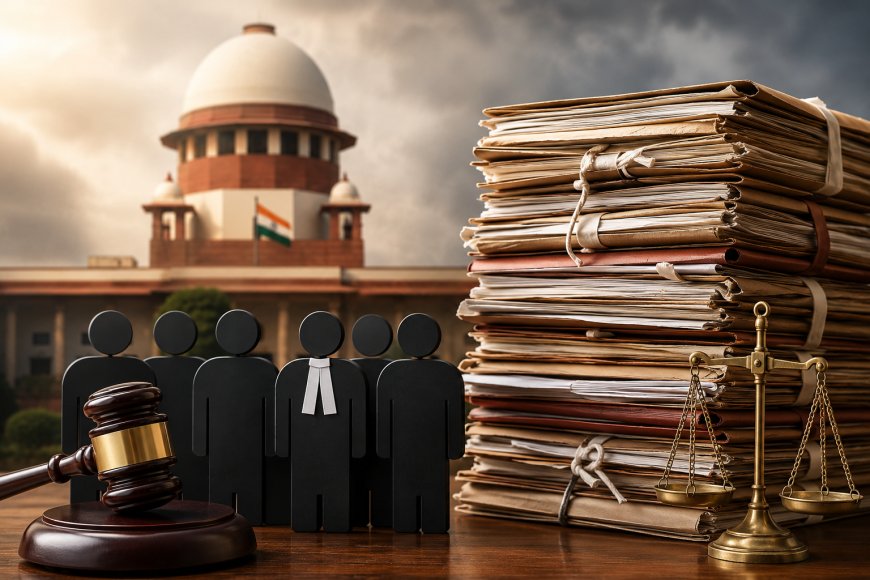
New Delhi: The Union government's decision to increase the sanctioned strength of the Supreme Court has revived a familiar debate: can more judges alone solve India's mounting judicial backlog?
At first glance, the proposal appears to be a logical response. Nearly 95,000 cases are pending before the Supreme Court, while subordinate courts are burdened with close to 4.8 crore cases. India also has one of the world's lowest judge-to-population ratios, with only about 21 judges per million people—far below the 50 per million recommended by the Law Commission decades ago.
Yet history suggests that increasing judicial strength, though necessary, has never been sufficient.
When the Supreme Court began functioning in 1950, it had just eight judges. Since then, Parliament has expanded its sanctioned strength multiple times, reaching 34 judges in 2019 and now proposing another increase. Despite every expansion, pendency has continued to rise. The trend indicates that while additional judges may improve disposal rates, they have not fundamentally altered the trajectory of mounting litigation.
The reason lies in the nature of India's judicial crisis. Pendency is not simply a manpower problem—it is also an institutional and procedural one.
One major contributor is the Supreme Court's ever-expanding jurisdiction. Through Special Leave Petitions (SLPs), the Court hears thousands of appeals that were originally intended to reach it only in exceptional circumstances. Over the years, the apex court has increasingly functioned as a regular appellate court rather than focusing primarily on constitutional interpretation and questions of national importance. The result is a docket crowded with routine disputes alongside constitutional cases.
Government litigation further compounds the problem. The Union and State governments remain the country's largest litigants, routinely challenging adverse orders and prolonging disputes through multiple appeals. Every unnecessary government appeal occupies judicial time that could otherwise be devoted to resolving long-pending cases.
Equally significant is the crisis in the lower judiciary, where the overwhelming majority of pending cases originate. Vacant judicial posts, inadequate infrastructure, shortage of court staff, delayed investigations, repeated adjournments and outdated administrative practices slow down the justice delivery process long before disputes reach constitutional courts. Unless these systemic bottlenecks are addressed, merely expanding the Supreme Court's strength will have only a limited impact on overall pendency.
The quality of judicial administration also deserves attention. Efficient case management, stricter regulation of adjournments, greater use of technology and wider adoption of mediation and arbitration can often produce larger gains than increasing judicial numbers alone. Several countries have demonstrated that judicial efficiency depends as much on management practices as on the number of judges available.
This is not an argument against appointing more judges. On the contrary, India's judicial vacancies must be filled urgently, and judicial strength should continue to increase in line with population growth and rising litigation. However, appointments should be viewed as one component of a broader reform agenda rather than the sole solution.
The larger challenge is to redesign how justice is delivered. Reducing unnecessary government litigation, strengthening subordinate courts, streamlining judicial appointments, modernising court infrastructure, limiting routine appeals before the Supreme Court and promoting alternative dispute resolution are reforms that can substantially reduce the flow of cases entering the system.
Ultimately, the debate should move beyond the arithmetic of judicial strength. The question is not whether India needs more judges—it unquestionably does. The real question is whether the justice system can become faster, more accessible and more efficient without simultaneously addressing the structural causes that generate and sustain judicial delays.
Increasing the number of Supreme Court judges may provide immediate relief. Lasting reform, however, will depend on whether India is prepared to modernise the institutions, procedures and litigation culture that have allowed judicial pendency to grow for decades.