What the 'RSS Friends' FARA Filing Does and Doesn't Mean
A US group named ‘RSS Friends’ registered under FARA, listing the RSS as its foreign principal. Here’s what the filing says and what it doesn’t show.
 Verdicto News Desk
A group calling itself "RSS Friends" has registered with the US Department of Justice under the Foreign Agents Registration Act (FARA), naming the Rashtriya Swayamsevak Sangh (RSS) as its "foreign principal." PTI reported the registration on 29 October 2026. The filing itself is dated 27 August, two days before RSS chief Mohan Bhagwat's "Universal Oneness Celebration" at Madison Square Garden on 29 August, organised by the American Hindus for Engagement and Dialogue (AHEAD) Forum.
The filing has already drawn attention in India. This explainer sets out what the law actually requires, what the filing says, and what it does not establish.
What the filing says
According to the registration , RSS Friends gave an address in Georgia and listed the RSS, at Keshavkunj, New Delhi, as its foreign principal. New agency reports three directors: Rajendra Sonarikar, Jayant Pant and Devananda Gaddam.
The group describes its proposed activities as primarily informational, educational, public-relations and community engagement work. It says it may communicate with the public, journalists, media organisations, researchers, academic and policy institutions, community leaders, civil society groups and, where appropriate, government agencies or officials. It also lists correcting or responding to information it believes is inaccurate, incomplete or lacking context.
The filing describes the RSS as an unincorporated India-based voluntary association.
What FARA is
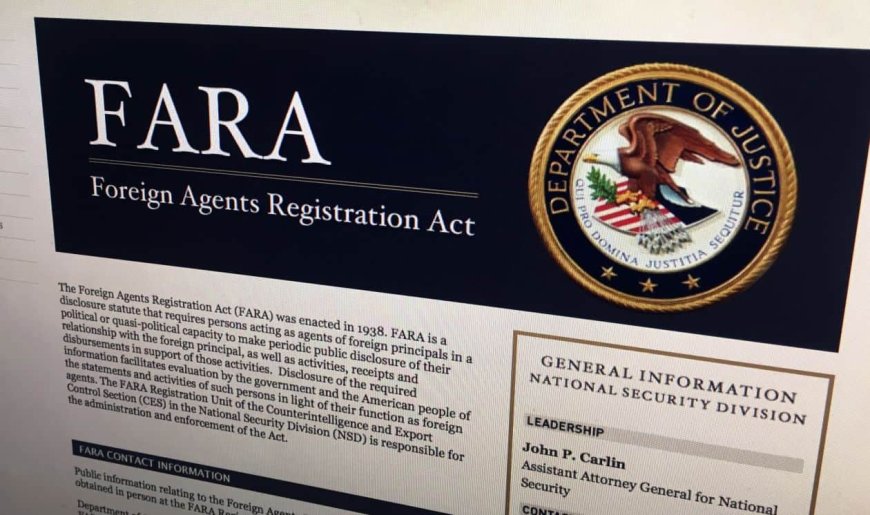
FARA (22 U.S.C. § 611 and following) is a disclosure statute. It does not ban any activity. It requires people acting in the United States as agents of a foreign principal, in a political or quasi-political capacity, to register with the Justice Department and to report their activities periodically. The registrations are public.
The stated purpose is transparency. The American public and lawmakers are meant to know when information or advocacy is being provided at the behest of a foreign principal.
The statute requires registration within ten days of agreeing to act as an agent. Willful failure to register can attract criminal penalties. The Justice Department also issued a general reminder on 16 September 2026 that failing to register can carry civil and criminal liability. [CHECK the press release before citing.] FARA also contains exemptions, including for certain non-political and commercial activities.
The "no written contract" disclaimer
The most legally interesting passage is the group's statement that it has no written employment, consulting, lobbying, public-relations or agency agreement with the RSS containing specified deliverables, compensation or detailed operational instructions.
The group immediately adds that this should not be read as a representation that no relationship, request, understanding, coordination, authorisation or direction exists. It says it will disclose the actual facts relevant to its activities.
That qualification matters because of how FARA treats the word "agent." The Justice Department has historically read it broadly. A formal contract, or payment from the foreign principal, is not required. An agreement or understanding to act on a foreign principal's behalf can be enough. A disclaimer about written contracts therefore does not by itself settle whether someone is an agent, which is presumably why the group framed it carefully.
What the filing does not show
Registration is not a finding of wrongdoing, and it is not an allegation. It does not establish that the RSS directed, funded or controlled the group's activities. Individuals and organisations connected to many countries register under FARA, and registering is what the law asks of anyone who may fall within it.
Nor does the registration, on its own, say anything about the content of the group's future activities. Those will be visible only through its follow-up filings.
What to watch next
- Follow-up filings. Periodic activity reports will show what the group does in practice: whom it contacts, what it publishes, whether it engages officials.
- Any response. Media reports does not carry a response from the RSS or RSS Friends.
- Supplemental statements. FARA registrants must update filings when facts change, so the description of the relationship may become more specific over time.
The broader point
FARA works by making relationships visible and leaving readers to judge them. Whatever one thinks of the RSS or its outreach, the useful reading of this story is a narrow one: a group has used a US transparency mechanism to disclose its connection to an Indian organisation, and the public record now exists for anyone to read.
Sources: FARA short-form registration statement filed 27 August 2026; US Department of Justice FARA guidance; Congressional Research Service overview of FARA. News agency report of 29 October 2026.