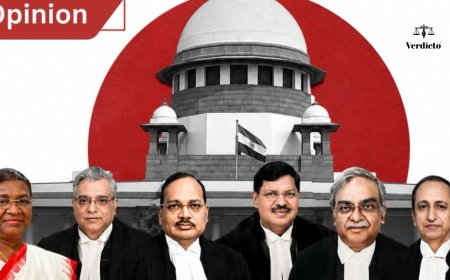
What CJI Surya Kant's Remarks Signal for the DPDP-RTI Case
As Centre prepares its reply on Section 44(3) of the DPDP Act, CJI Surya Kant's remarks suggest the Supreme Court is weighing what balancing test survives, not whether the RTI amendment stands.
 Verdicto News Desk
The distance between February and Friday is instructive less for what changed than for what stayed fixed. On 16 February, the Supreme Court issued notice on three petitions challenging Section 44(3) of the DPDP Act and declined to stay it, reasoning that an interim order should not thwart a parliamentary regime before the case had been heard. On Friday, Chief Justice Surya Kant, sitting with Justices Joymalya Bagchi and V Mohana, directed the Centre to actually file that response within two to three weeks, a procedural escalation, not a substantive one. The refusal to stay still holds. What is worth reading closely is not the order but the exchange that produced it, because it indicates the terms on which this case will likely be decided.
Vrinda Grover and Prashant Bhushan, arguing for the petitioners, made two distinct arguments that are often collapsed into one in public commentary. Grover's submission was structural: the earlier Section 8(1)(j) contained inbuilt safeguards a relationship test to public activity, an unwarranted-invasion-of-privacy standard, and a public interest override all of which the substituted clause omits, leaving personal information exempt without any balancing exercise at all.
Bhushan's submission was doctrinal: that this balance was not merely good drafting but settled law, citing the judgment authored by then Justices D Y Chandrachud and N V Ramana that had already reconciled the right to information under Article 19(1)(a) with the right to privacy, and had found the original RTI Act's formulation adequate to that reconciliation. The distinction matters because it sets up two different grounds on which the amendment could fall — arbitrariness in withdrawing a safeguard without replacement, or inconsistency with a constitutional balance the Court had already struck. A bench could accept one without the other.
What the CJI said in response is the more revealing data point for anyone trying to forecast where this goes. His observation that some balancing would have to be done regarding the kind of digital personal data requiring protection does not concede the petitioners' structural argument, but it does not accept the government's position either. It restates, from the bench, the same harmonisation frame the Court used in February when it described the DPDP Act and RTI Act as central legislations requiring reconciliation rather than a hierarchy where one simply displaces the other.
Read against Solicitor General Tushar Mehta's defence that the amendment harmonises RTI with the fundamental right to privacy rather than blocking legitimate transparency the two positions are not as far apart procedurally as the petitioners' rhetoric suggests. Both sides are now arguing about the content of a balancing test, not about whether one should exist. That is a narrower fight than "repeal RTI" versus "protect privacy," and it is the fight the Centre's forthcoming reply will have to engage on the Court's terms.
This matters for how the interim period should be reported. The amendment remains operative, and Bhushan's examples charge sheets against public officials, welfare scheme and ration card records withheld as personal information describe the live consequence of that operation, not a hypothetical one. But the Court's own framing suggests the eventual outcome is unlikely to be a binary validity ruling. It is more likely to turn on what "balancing" is judicially read back into a provision that currently contains none — whether through reading down the exemption, importing a proportionality standard, or some other construction that leaves Section 44(3) technically intact while narrowing its practical reach. Coverage that treats this case as building toward a stay or a strike-down risks setting up an outcome the bench has not signalled and may not deliver.
The more defensible framing, consistent with what has actually been said in court across both hearings, is that the Centre now has three weeks to explain what balancing test it thinks survives inside a clause its own drafters removed the balancing language from and that answer, more than any procedural order to date, is what will determine whether this amendment stands.