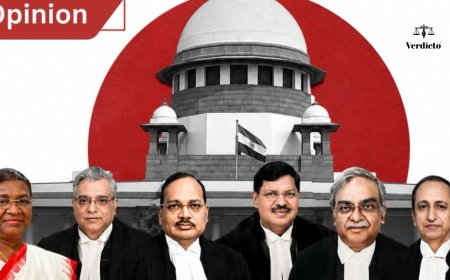
Supreme Court Strikes Down MP Notification Exempting Lokayukta's SPE from RTI Act
Supreme Court rules that Madhya Pradesh Lokayukta's Special Police Establishment is not an intelligence or security organisation and cannot be exempted from the RTI Act.
 Verdicto News Desk
New Delhi, June 15: In a significant judgment strengthening transparency and accountability in anti-corruption investigations, the Supreme Court on Monday held that the Special Police Establishment (SPE), the investigating wing of the Madhya Pradesh Lokayukta, cannot be classified as an "intelligence and security organisation" and therefore cannot be exempted from the ambit of the Right to Information (RTI) Act, 2005.
A Bench of Justices J.K. Maheshwari and A.S. Chandurkar struck down a Madhya Pradesh government notification dated August 25, 2011, which had sought to exclude the SPE from the purview of the RTI Act.
The Court held that the notification was "bad in law" and "excessive in nature" as it failed to satisfy the requirements of Section 24(4) of the RTI Act, which permits state governments to exempt only intelligence and security organisations from disclosure obligations.
SPE Not an Intelligence or Security Agency
Examining the statutory framework governing the Lokayukta and its investigative wing, the Court observed that the SPE primarily assists the Lokayukta and Up-Lokayukta in investigating allegations of corruption and misconduct by public servants under the Madhya Pradesh Lokayukt Evam Up-Lokayukt Adhiniyam, 1981.
The Bench noted that neither the Lokayukta nor the Up-Lokayukta is empowered to conduct inquiries relating to intelligence or national security matters. Consequently, an agency functioning under their jurisdiction cannot be treated as an intelligence or security organisation merely because it conducts investigations.
"The SPE cannot be termed to be an intelligence and security organisation when it assists the Lokayukta or the Up-Lokayukta in matters specified under Section 7 of the 1981 Act," the Court observed.
The Court further noted that the SPE's jurisdiction is largely confined to investigating offences under the Prevention of Corruption Act and certain provisions of the Indian Penal Code involving public servants.
Challenge Originated from RTI Application
The case arose from an RTI application filed by Kamta Prashad Mishra, a former town inspector posted at Madhav Nagar Police Station in Katni.
Mishra was implicated in a trap case registered by the SPE in April 2017. After the Madhya Pradesh Home Department granted sanction for his prosecution in May 2020, he sought information under the RTI Act regarding the decision-making process behind the sanction order.
His RTI request was rejected by authorities, and the denial was subsequently upheld by the State Information Commission. Mishra then approached the Madhya Pradesh High Court, which directed that the requested information be furnished.
Challenging the High Court's order, the SPE moved the Supreme Court, arguing that it was exempt from the RTI Act and that disclosure of the information could impede an ongoing investigation under Section 8(1)(h) of the RTI Act.
Court Upholds Transparency Principle
Rejecting the SPE's broader claim of blanket exemption, the Supreme Court held that Section 24(4) could only apply to organisations genuinely engaged in intelligence and security functions.
The Bench emphasised that investigative agencies dealing with corruption allegations against public servants cannot automatically claim such protection merely by virtue of conducting investigations.
Importantly, the Court also reaffirmed the judiciary's power to examine the validity of subordinate legislation even in the absence of a specific challenge. It observed that courts are not precluded from scrutinising the legality of government notifications if their validity becomes relevant during proceedings.
The judgment noted that subordinate legislation does not enjoy the same degree of constitutional protection as laws enacted by Parliament or state legislatures and remains subject to judicial review.
Notification Struck Down
While upholding the Madhya Pradesh High Court's decision, the Supreme Court struck down the 2011 notification insofar as it exempted the SPE from the RTI Act.
However, the Court clarified that it had not examined the validity of the notification concerning the State Bureau of Investigation for Economic Offences and therefore allowed the notification to continue operating in relation to that body.
Why the Judgment Matters
The ruling is expected to have broader implications for transparency in anti-corruption investigations conducted by Lokayukta institutions across the country. By narrowing the scope of exemptions under Section 24 of the RTI Act, the Supreme Court has reinforced the principle that investigative agencies cannot be shielded from public scrutiny unless they genuinely perform intelligence or security functions.
The decision is also likely to influence future disputes involving claims of RTI exemption by specialised investigative agencies functioning under state governments.