Supreme Court Petition Seeks Dissolution of NTA Over NEET-UG 2026 Exam Leak
A writ petition filed in the Supreme Court seeks dissolution of the NTA over the alleged NEET-UG 2026 paper leak, demanding a statutory national testing authority, parliamentary oversight, and stricter accountability measures.
 Verdicto News Desk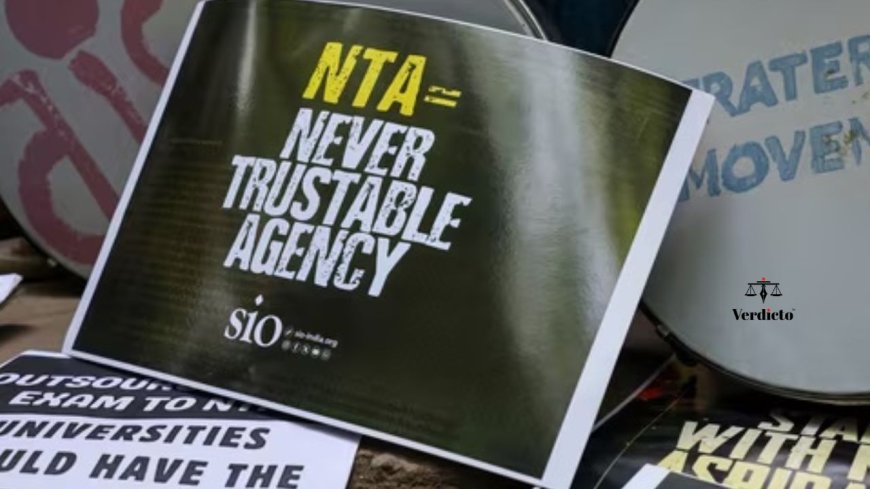
A writ petition has been filed before the Supreme Court of India by the United Doctors Front (UDF), demanding the dissolution of the National Testing Agency (NTA) following the alleged “systemic failure” in conducting the NEET-UG 2026 examination.
The petition, filed through Advocate Ritu Reniwal, calls for the establishment of a statutory national testing authority through legislation enacted by Parliament. According to the plea, the new body should operate with clearly defined legal powers, transparency mechanisms, and direct accountability to Parliament.
The petition argues that the NTA’s present structure as an autonomous society registered under the Societies Registration Act, 1860 has created an “accountability vacuum.” It states that unlike constitutional or statutory bodies such as the UPSC and SSC, the NTA is not directly answerable to Parliament and remains outside mandatory parliamentary scrutiny and Comptroller and Auditor General (CAG) audits.
The plea further seeks mandatory statutory penalties for paper leaks and demands the formation of a court-monitored committee to supervise future national examinations and ensure “zero-leak” integrity.
The petition comes after the cancellation of the NEET-UG 2026 examination conducted on May 3, 2026, amid allegations of a paper leak. The matter was later handed over to the Central Bureau of Investigation (CBI) for investigation.
According to the petition, NEET-UG is the sole gateway for undergraduate medical admissions in India and directly impacts the future of over 22.7 lakh students. It claims that repeated examination leaks violate Articles 14 and 21 of the Constitution, which guarantee equality and the right to life and livelihood.
The plea alleges that despite advanced security measures such as GPS tracking, AI-assisted CCTV monitoring, and biometric verification, the examination was compromised through an organized “Guess Paper” racket. Investigations by the Rajasthan Special Operations Group and subsequent CBI FIRs reportedly confirmed that examination material had been circulated digitally before the exam date.
The petition also refers to earlier observations made by the Supreme Court in the NEET-UG 2024 matter, where the Court had warned the NTA against administrative lapses and inconsistent handling of examination issues. It additionally cites recommendations of the K. Radhakrishnan Committee, which suggested reducing dependence on private vendors and adopting computer-based or hybrid examination systems.
The UDF has argued that despite the implementation of the Public Examinations (Prevention of Unfair Means) Act, 2024, authorities failed to curb organized cheating networks and recurring paper leaks.
The petition highlights the severe psychological, academic, and financial impact of repeated examination failures on students and families across the country. It also mentions student suicides allegedly linked to examination-related stress and uncertainty.
Among the key reliefs sought, the petition requests:
- Dissolution of the NTA in its current form
- Creation of a statutory national testing authority through parliamentary legislation
- Mandatory transparency and accountability measures
- Direct parliamentary oversight and CAG audits
- Appointment of a court-monitored committee for future national examinations
The case is expected to draw significant national attention as concerns over examination integrity and student welfare continue to grow across India.
📌 Follow us on YouTube, Instagram, and Twitter for more updates.