Supreme Court Debates Limits of Religious Freedom and Social Reform in Sabarimala Case
Supreme Court hears Sabarimala reference case, debating religious freedom, social reform, women’s equality, and limits of the ERP doctrine.
 Verdicto News Desk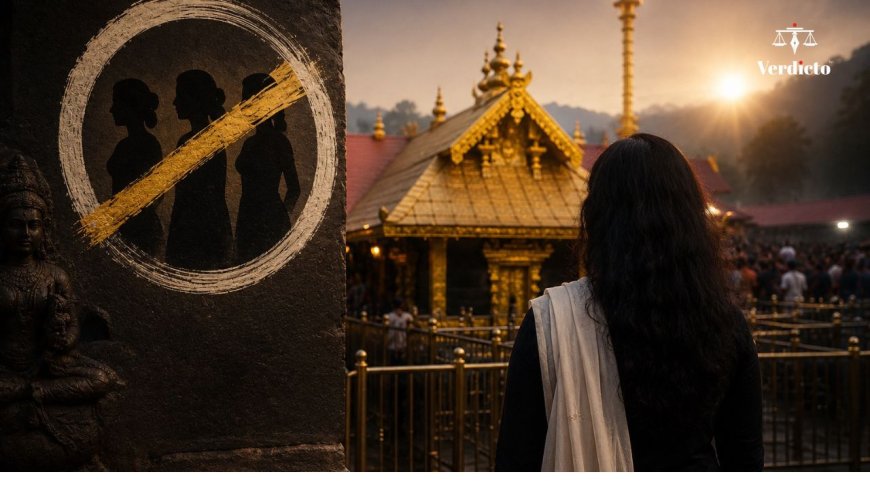
The Supreme Court on Wednesday continued hearing the Sabarimala reference matter, where senior advocates debated the delicate balance between religious freedom and social reform under the Indian Constitution.
Appearing for the Kerala government, Senior Advocate Jaideep Gupta argued before the nine-judge bench that social reform has been intentionally placed within the framework of religious freedom because discriminatory social practices are often protected under the guise of religion. He stated that courts may need to examine religious customs while deciding issues linked to reform and equality.
Gupta emphasized that Article 25(2)(b) of the Constitution empowers the State to introduce welfare and reform measures, even if they affect certain religious practices. According to him, reform cannot be blocked merely because a practice is claimed to be religious.
Justice B.V. Nagarathna, however, cautioned that social reform cannot override constitutionally protected religious freedoms under Article 25(1). The judge observed that while the State has powers to reform society, such intervention should not “hollow out religion.”
During the hearing, Gupta clarified the role of the “Essential Religious Practices” (ERP) test, explaining that courts are not deciding theology but only determining whether a practice is genuinely religious and whether it is essential to that faith.
Senior Advocate Menaka Guruswamy opposed excessive reliance on the ERP doctrine and instead advocated the use of the proportionality test. She argued that proportionality allows courts to examine whether restrictions on rights are justified, necessary, and balanced, without forcing judges into theological interpretations.
Guruswamy highlighted the historical exclusion faced by marginalized communities in religious spaces. Referring to Rule 3 of the Kerala Hindu Places of Public Worship Rules, 1965, she argued that restrictions imposed on women at Sabarimala are unconstitutional and violate Article 15(2), which prohibits discrimination based on sex in access to public spaces and facilities.
Senior Advocate Shadan Farasat also questioned the ERP doctrine, suggesting that courts should first determine whether a person’s belief is sincerely religious and then resolve conflicts between rights through proportionality analysis.
On the interpretation of Articles 25 and 26, Senior Advocate Vijay Hansaria argued that Article 26 cannot claim superiority over Article 25 because it lacks a non-obstante clause. He maintained that individual rights to worship must remain protected even when religious denominations claim administrative autonomy.
Meanwhile, Senior Advocate Sanjay Hegde provided historical context to the constitutional provisions, noting that the framers of the Constitution drafted Articles 25 and 26 after witnessing religious violence, Partition, and global extremism. He argued that the Constitution was designed to prevent religion from becoming a tool of exclusion and oppression.
The hearing in the landmark Sabarimala reference case will continue before the Supreme Court’s nine-judge bench.
📌 Follow us on YouTube, Instagram, and Twitter for more updates.