Supreme Court Flags Misuse Of Advocates’ Welfare Stamps In E-Filed Vakalatnamas
The Supreme Court has raised concerns over the alleged misuse of advocates’ welfare stamps in e-filed vakalatnamas, warning of significant revenue losses to lawyers’ welfare funds and considering measures like e-stamping to prevent fraud.
 Verdicto News Desk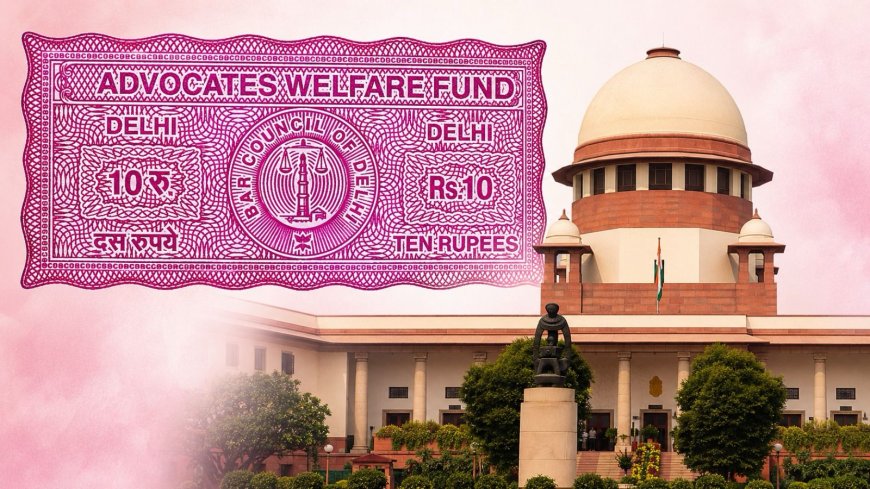
NEW DELHI: The Supreme Court on Monday raised serious concerns over the alleged misuse of advocates’ welfare stamps in vakalatnamas filed through the e-filing system, observing that the practice could lead to significant financial losses for welfare funds meant for lawyers.
A Bench of Justices PS Narasimha and Alok Aradhe was informed that some advocates were allegedly reusing scanned copies of the same welfare stamp across multiple vakalatnamas submitted electronically before the Court.
The issue was brought to the Court’s notice by Additional Solicitor General SD Sanjay, appearing for the Supreme Court Registry, during the hearing of a petition filed by the Supreme Court Bar Association (SCBA) seeking the creation of a separate welfare fund for advocates practising before the apex court.
ASG Sanjay submitted that the current welfare stamps do not contain any distinctive security features, making them vulnerable to misuse in the digital filing process.
“Lawyers are purchasing a single advocates’ welfare stamp and scanning it and attaching it in a hundred vakalatnamas filed through the e-filing portal because there is no distinctive feature in the stamp. Earlier, during physical filing, the stamp used to be cut, but now it is no longer possible,” he told the Court.
Reacting to the submission, SCBA President Vikas Singh described the practice as alarming and termed it a form of fraud. He suggested the introduction of an electronic stamping mechanism to prevent duplication and misuse.
“If the same stamp is being used repeatedly, it is a kind of fraud. There should be e-stamping because a physical stamp can be bought once and photocopies can then be attached to multiple vakalatnamas,” Singh submitted.
Justice Narasimha then questioned whether clients signed the welfare stamps along with the vakalatnama. In response, the ASG clarified that while clients sign the vakalatnama, they do not sign the welfare stamp itself.
Observing the seriousness of the matter, Justice Narasimha remarked that the practice was causing a “huge loss of revenue” to advocates’ welfare funds and said the Court would ask its committee to examine the issue.
The hearing also dealt with the broader demand raised by the Supreme Court Bar Association for a dedicated welfare fund for lawyers practising in the Supreme Court. Senior Advocate S Gurukrishna Kumar, appearing for the Bar Council of India, sought additional time to place the Council’s policy before the Court, following which the Bench granted two weeks’ time.
In its petition, the SCBA argued that welfare stamp proceeds collected from vakalatnamas filed in the Supreme Court are currently transferred to the Advocates Welfare Trust under the Bar Council of Delhi, despite Supreme Court practitioners allegedly not receiving corresponding welfare benefits.
The petition challenges the present framework under the Advocates’ Welfare Fund Act, 2001, which mandates the use of welfare stamps on vakalatnamas filed before courts. Under the existing system, the revenue generated through these stamps is credited to State Bar Council welfare funds.
The SCBA contended that there is presently no mechanism to specifically allocate funds generated from Supreme Court filings for the welfare of advocates regularly practising before the apex court.
📌 Follow us on YouTube, Instagram, and Twitter for more updates.